poinsettia
Euphorbia pulcherrima Willd. ex Klotzsch
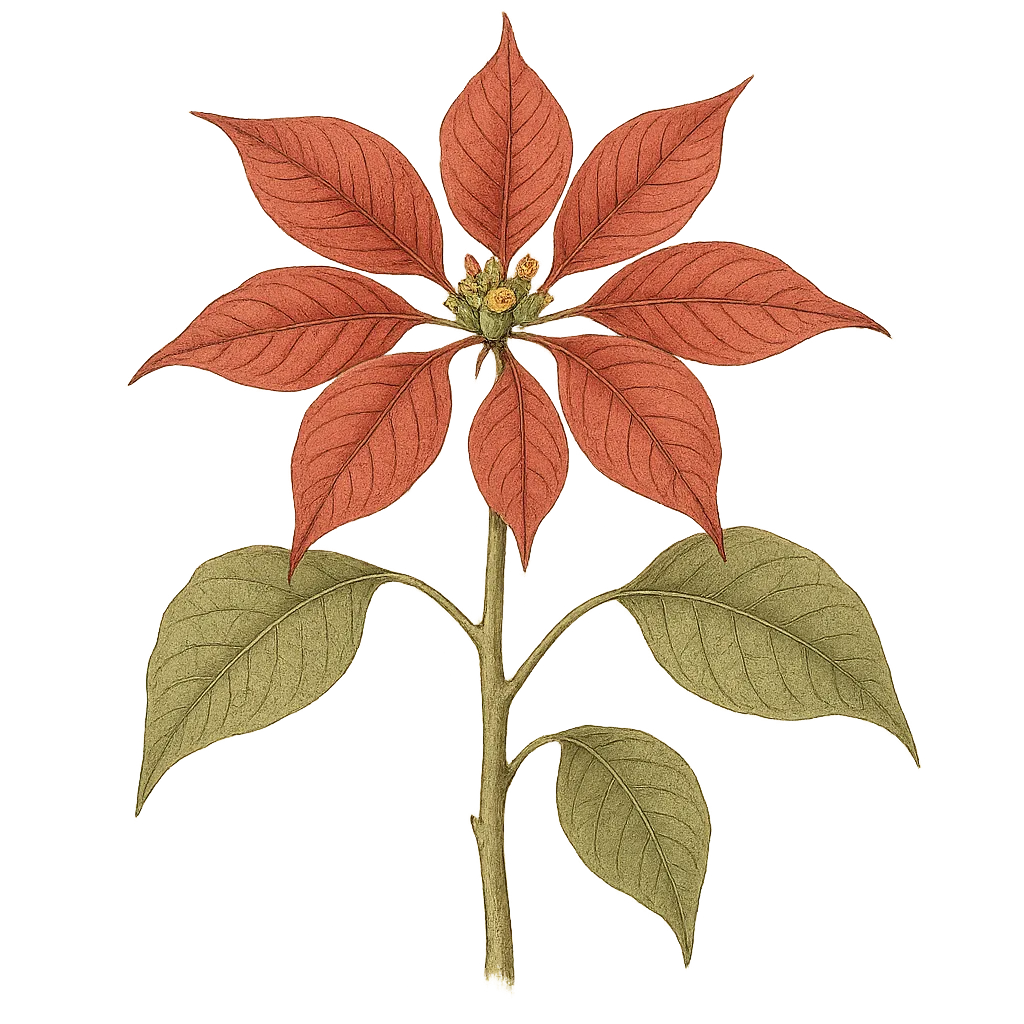
Poinsettia’s brilliant display is largely made of modified leaves. The broad coloured bracts surround much smaller reproductive structures. Although often seen as a compact holiday pot plant, this is naturally a shrub or small tree, with deciduous to partly evergreen foliage and a potential height of about three metres. NC State Extension: Poinsettia
Botanical name
Kew accepts Euphorbia pulcherrima Willd. ex Klotzsch in the spurge family, matching the catalog name. Kew POWO: Euphorbia pulcherrima
Recognizing the plant
Dark green leaves are egg-shaped and arranged alternately, with edges that may be smooth, toothed or lobed. The erect stems release milky sap when damaged. Above the showy bracts sit small cup-shaped flower clusters called cyathia, with conspicuous yellow glands on their rims. Cultivated bracts come in red, pink, white, peach and patterned combinations. The coloured leaves and the tiny flower clusters are separate parts of the same display. NC State Extension: Poinsettia
Seasonal development
North American cultivation
Long, uninterrupted nights promote the coloured winter display. North Carolina’s account records flowering from winter into spring. NC State Extension: Poinsettia
Native range
The species is native from Mexico to Guatemala, where it belongs to seasonally dry tropical vegetation. The extension account records coastal habitats and dry tropical forests. Kew POWO: Euphorbia pulcherrimaNC State Extension: Poinsettia
Botanical sources
Reviewed 2026-10-11. Seasonal development varies with location and growing conditions.