Portuguese daisy
Leucanthemum lacustre (Brot.) Samp.
Portuguese daisy is a substantial perennial, usually 30–120 cm tall but occasionally exceeding 2 m. Its stems can remain unbranched or divide near their tips. Long-stalked basal leaves and shorter-stalked or stalkless stem leaves create a gradual change in outline from the base upward. Flora of North America: Leucanthemum lacustre
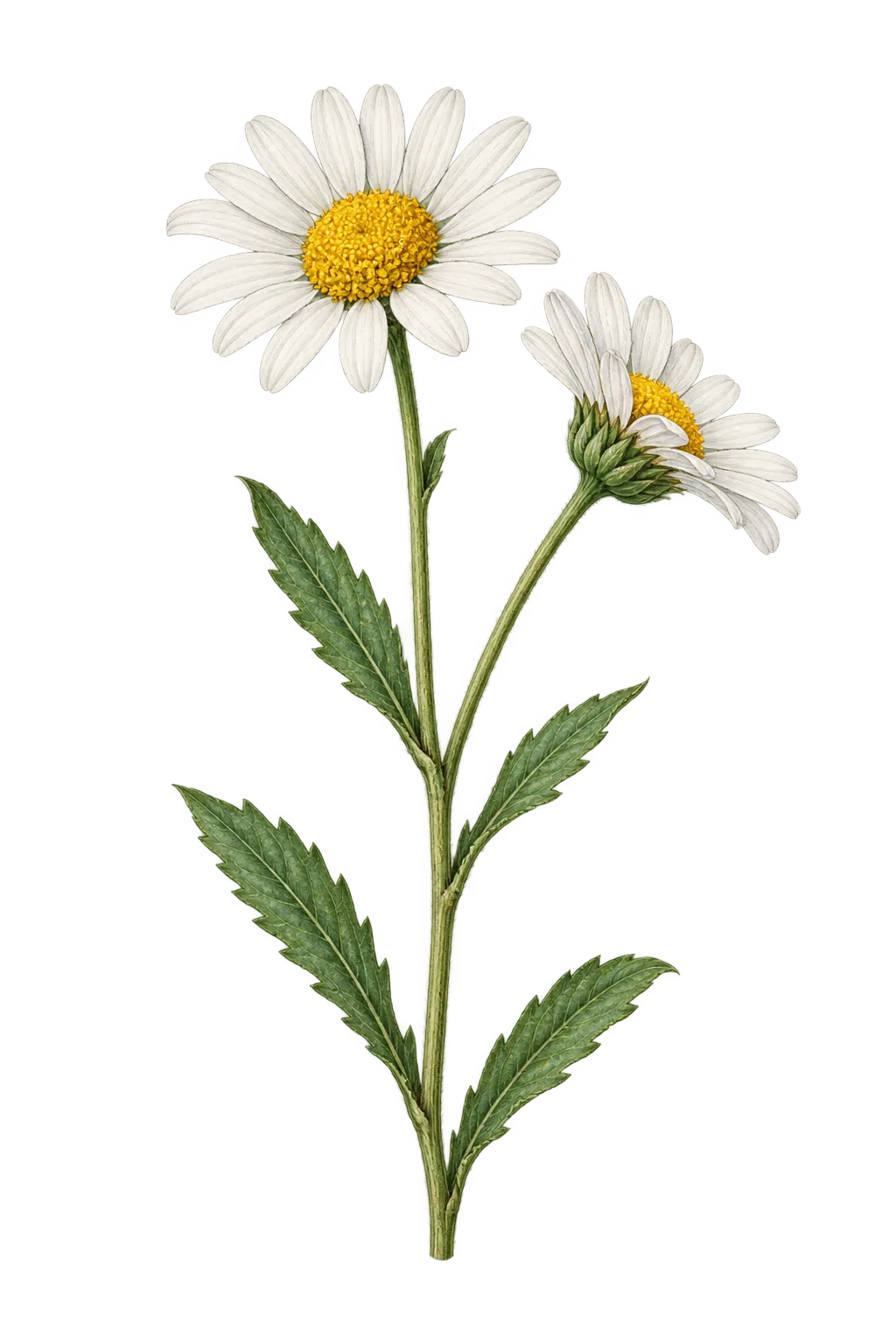
Botanical name
Leucanthemum lacustre (Brot.) Samp. is accepted in Asteraceae. It is a Portuguese species; the name should not be replaced by the hybrid Shasta daisy, Leucanthemum × superbum. Kew Plants of the World Online: Leucanthemum lacustre
Recognizing the plant
The basal leaf blades are lance-shaped and usually toothed without deep lobes. Mid-stem leaves are elliptical or broader toward the tip; their lower margins are often smooth, becoming regularly saw-toothed farther out. Each flower head has a ring of white ray florets around the yellow disk. The rays commonly number about twenty to thirty-four or more, with their strap-shaped portions around 2–3.5 cm long. Beneath the head, broad overlapping bracts form a protective cup. Small dry fruits produced by the ray flowers often carry an ear-like extension at the apex. Flora of North America: Leucanthemum lacustreGreat Plains Herbaria: Leucanthemum, Flora of North America genus description
Bloom window
California, United States
The North American flora reports spring–summer flowering in its introduced Californian range. Flora of North America: Leucanthemum lacustre
Native range
Its native range is west-central Portugal. It has been introduced to places including California, Madeira and the Azores. Californian records include disturbed meadows, seeps and clearings near sea level. Kew Plants of the World Online: Leucanthemum lacustreFlora of North America: Leucanthemum lacustre
Botanical sources
- Kew Plants of the World Online: Leucanthemum lacustre
- Flora of North America: Leucanthemum lacustre
- Great Plains Herbaria: Leucanthemum, Flora of North America genus description
Reviewed 2026-10-11. Seasonal development varies with location and growing conditions.