rosemary
Salvia rosmarinus Spenn.
Rosemary carries much of its character in its foliage: narrow evergreen leaves release the familiar resinous aroma used in cooking and perfumery. New shoots are flexible, but older branches become woody and can develop a substantial trunk. Most upright garden forms grow into rounded shrubs rather than remaining small herbs. Kew Plants of the World Online: Salvia rosmarinusNC State Extension: Salvia rosmarinus
Botanical name
Rosmarinus officinalis L. is a homotypic synonym of the accepted Salvia rosmarinus Spenn. Rosemary is now included with the sages in Salvia. Kew Plants of the World Online: Salvia rosmarinus
Recognizing the plant
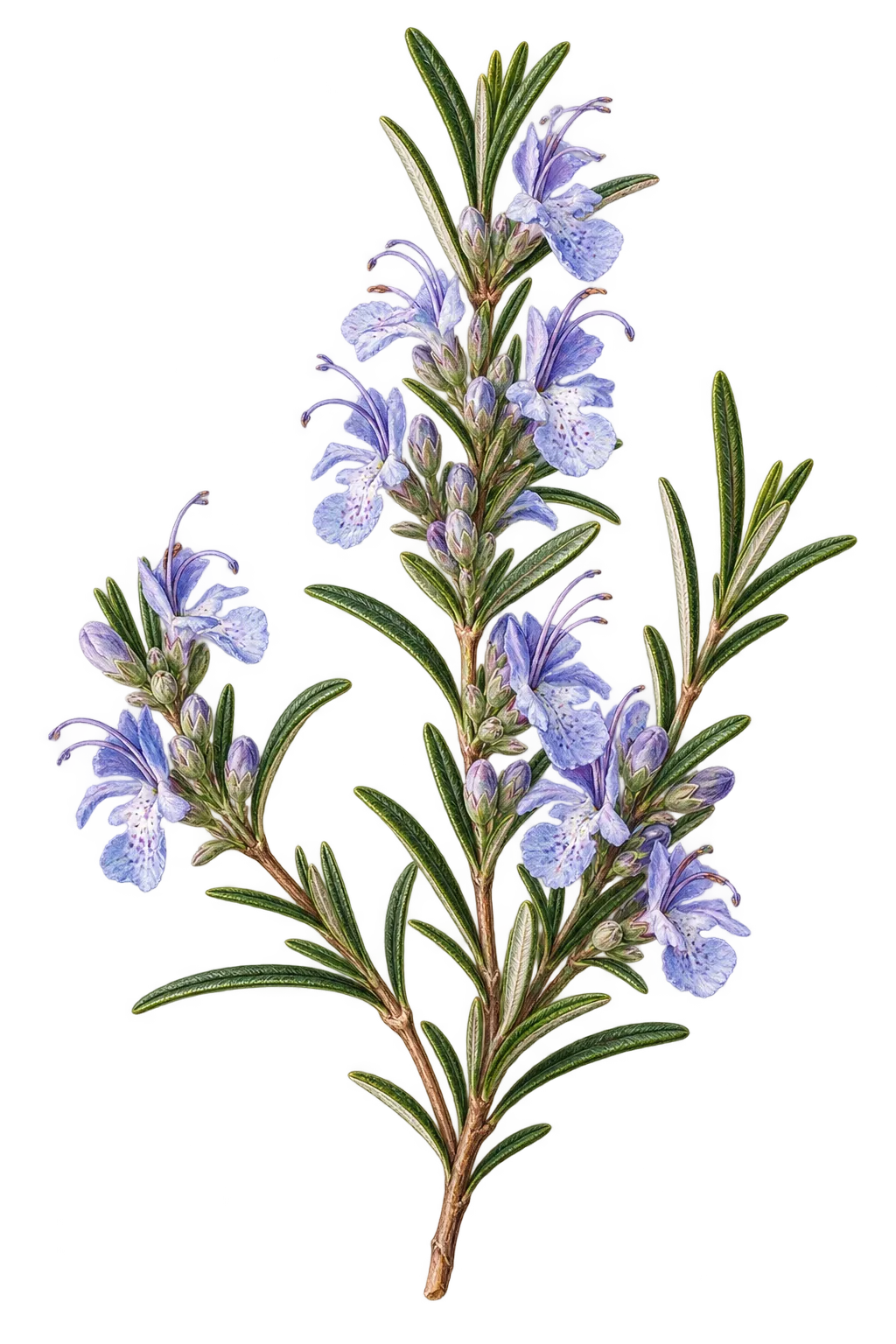
Leaves sit in opposite pairs. They are green above and whitish beneath, where a dense covering of hairs creates a felted surface. The young stems are square in cross-section. Small blue, lavender or white flowers cluster at the leaf axils and are strongly divided into two lips. Two long stamens project from each flower. The fruit separates into four dry, one-seeded nutlets. Kew Plants of the World Online: Salvia rosmarinusNC State Extension: Salvia rosmarinus
Bloom window
North Carolina cultivation
North Carolina Extension describes the usual garden flowering period as spring into summer. NC State Extension: Salvia rosmarinus
Native range
Rosemary is native around the Mediterranean basin, where it grows in dry scrubland and rocky, sunny places. It has been cultivated widely outside that region, with established introductions on Atlantic islands and in other temperate and subtropical areas. Kew Plants of the World Online: Salvia rosmarinus
Ecological relationships
The flowers attract visiting bees and butterflies, as documented by North Carolina Extension. NC State Extension: Salvia rosmarinus
Botanical sources
Reviewed 2026-10-11. Seasonal development varies with location and growing conditions.