rushleaf jonquil
Narcissus assoanus Dufour ex Schult. & Schult.f.
Rushleaf jonquil is a small bulbous perennial, often only 10–15 cm tall. A flowering stem usually carries one deep-yellow flower, although two or three can occur. The flower combines a long, narrow tube with a conspicuous cup-shaped corona, giving a surprisingly elaborate structure to such a low plant. Papuga et al., Variation of a floral polymorphism in Narcissus assoanusCesaro et al. (2004), Experimental evaluation of self-interference in Narcissus assoanus
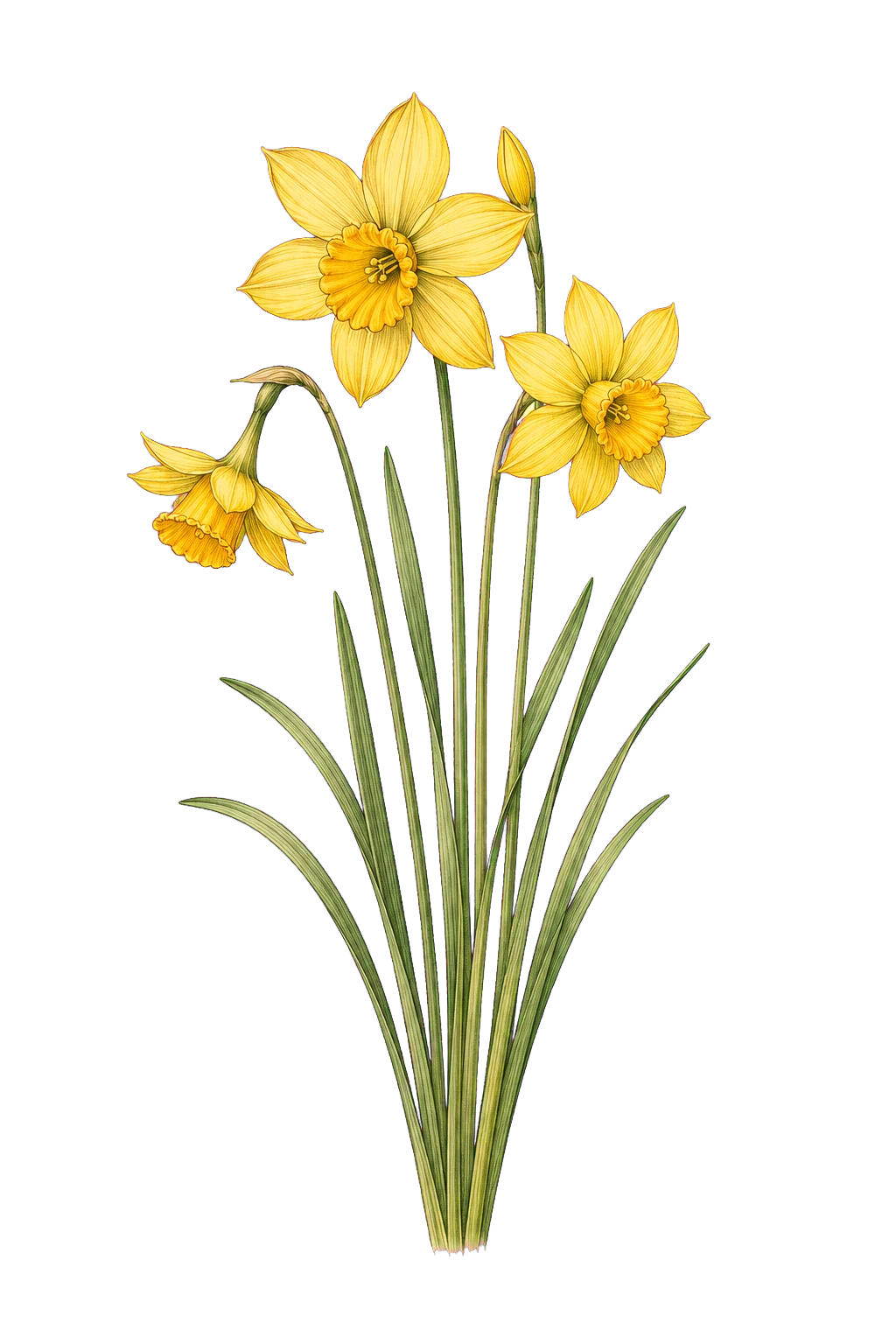
Botanical name
Kew accepts Narcissus assoanus Dufour ex Schult. & Schult.f. in Amaryllidaceae; the supplied author citation is abbreviated. Kew Plants of the World Online: Narcissus assoanus
Recognizing the plant
Its reproductive organs occur in two arrangements. Long-styled flowers hold the stigma close to or above the anthers; short-styled flowers keep it much deeper inside the floral tube. Both forms have six anthers arranged at two heights. The bulb is about 1–3 cm across, and the fruit is a nearly spherical capsule. Papuga et al., Variation of a floral polymorphism in Narcissus assoanusUniversity of the Balearic Islands, Herbari Virtual: Narcissus assoanus
Bloom window
Mediterranean France
In Mediterranean France, flowering runs from March into early May, with timing varying with elevation. Papuga et al., Variation of a floral polymorphism in Narcissus assoanus
Native range
Kew places the native range in southern France and eastern and southern Spain. In Mediterranean France it occupies open scrub and stony pastures on limestone, from lowland sites into the hills. Kew Plants of the World Online: Narcissus assoanusPapuga et al., Variation of a floral polymorphism in Narcissus assoanus
Ecological relationships
Field studies document pollination by Cleopatra butterflies, hummingbird hawkmoths and solitary bees of the genus Anthophora. Cesaro et al. (2004), Experimental evaluation of self-interference in Narcissus assoanus
Botanical sources
- Kew Plants of the World Online: Narcissus assoanus
- Papuga et al., Variation of a floral polymorphism in Narcissus assoanus
- University of the Balearic Islands, Herbari Virtual: Narcissus assoanus
- Cesaro et al. (2004), Experimental evaluation of self-interference in Narcissus assoanus
Reviewed 2026-10-11. Seasonal development varies with location and growing conditions.