rusty foxglove
Digitalis ferruginea L.
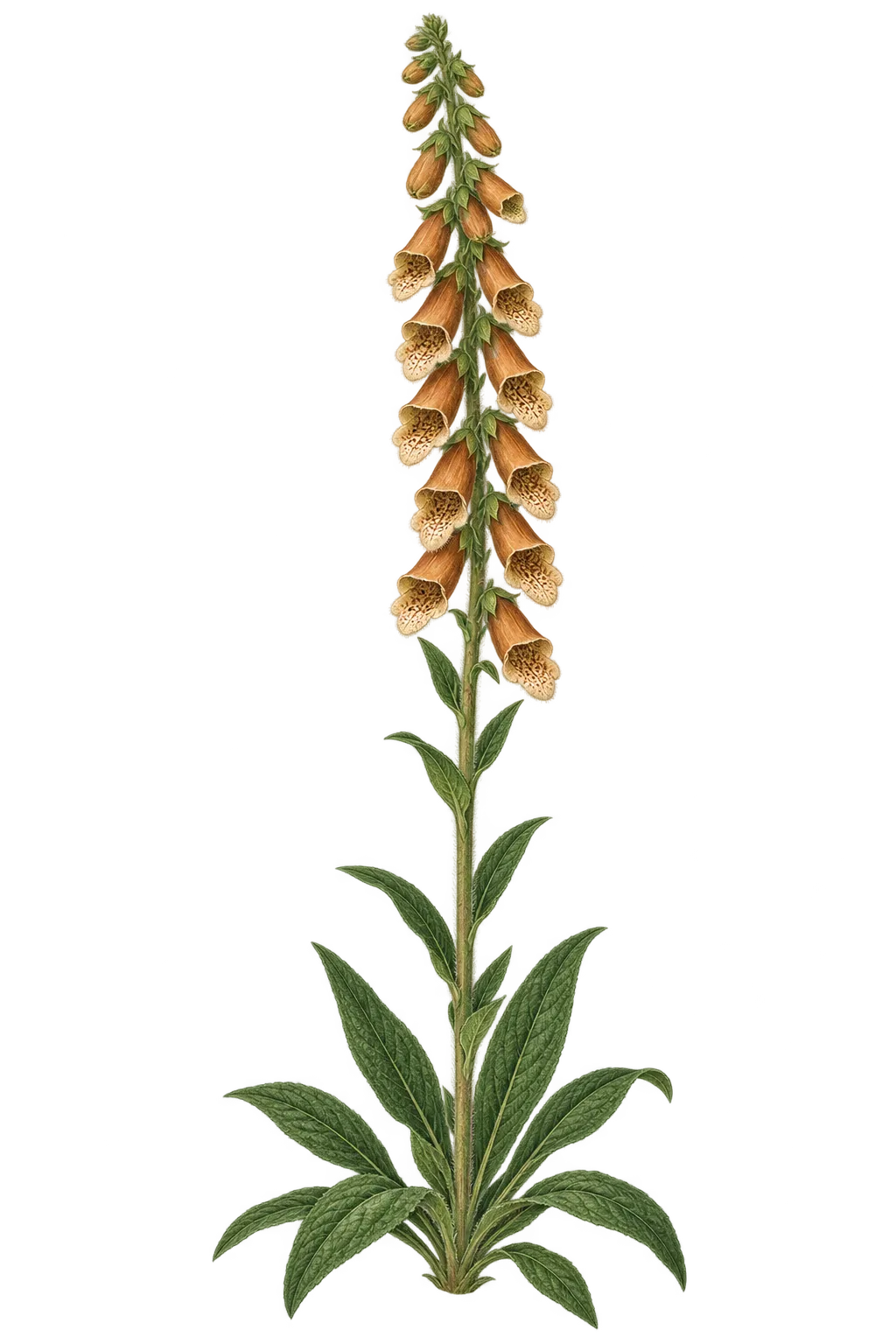
Rusty foxglove gives the familiar foxglove silhouette an unusual palette. Instead of clear purple or white, its flowers range through yellow-brown and rusty red, marked inside with darker veins. A slender, crowded raceme rises above closely arranged lance-shaped leaves, producing a strongly vertical plant. Botanischer Garten Frankfurt: Digitalis ferruginea
Botanical name
Kew accepts Digitalis ferruginea in Plantaginaceae. The account concerns the species, not a named garden cultivar. Plants of the World Online: Digitalis ferruginea
Recognizing the plant
The Frankfurt Botanical Garden describes it as a biennial or short-lived perennial, usually bearing a single unbranched stem that can approach 1.8 metres. The narrow flower cluster and densely placed foliage make its outline useful for recognition even before individual blossoms are examined. At suitable garden sites it can renew its presence by self-sowing, so a planting may persist through successive individuals rather than one exceptionally long-lived crown. Botanischer Garten Frankfurt: Digitalis ferruginea
Bloom window
Chicago, Illinois, United States
Chicago Botanic Garden lists May–June flowering for its regional garden conditions. Chicago Botanic Garden: Digitalis ferruginea
Native range
Kew places its native range from Hungary toward the Caucasus and Lebanon. Frankfurt’s account similarly locates it in southern and southeastern Europe, Turkey, the Caucasus and the Near East, and describes sunny to partly shaded woodland margins and open scrub as congenial settings. Plants of the World Online: Digitalis ferrugineaBotanischer Garten Frankfurt: Digitalis ferruginea
Botanical sources
- Plants of the World Online: Digitalis ferruginea
- Botanischer Garten Frankfurt: Digitalis ferruginea
- Chicago Botanic Garden: Digitalis ferruginea
Reviewed 2026-10-11. Seasonal development varies with location and growing conditions.