San Bernardino vervain
Verbena abramsii Moldenke
San Bernardino vervain has a debated identity. In Guy Nesom’s 2010 treatment, it is a taprooted perennial whose spreading stems can root where their nodes meet the ground. His description distinguishes it by its small calyx and prostrate growth, while acknowledging possible overlap with Verbena lasiostachys. Nesom, 2010: Is Verbena abramsii distinct from V. lasiostachys?
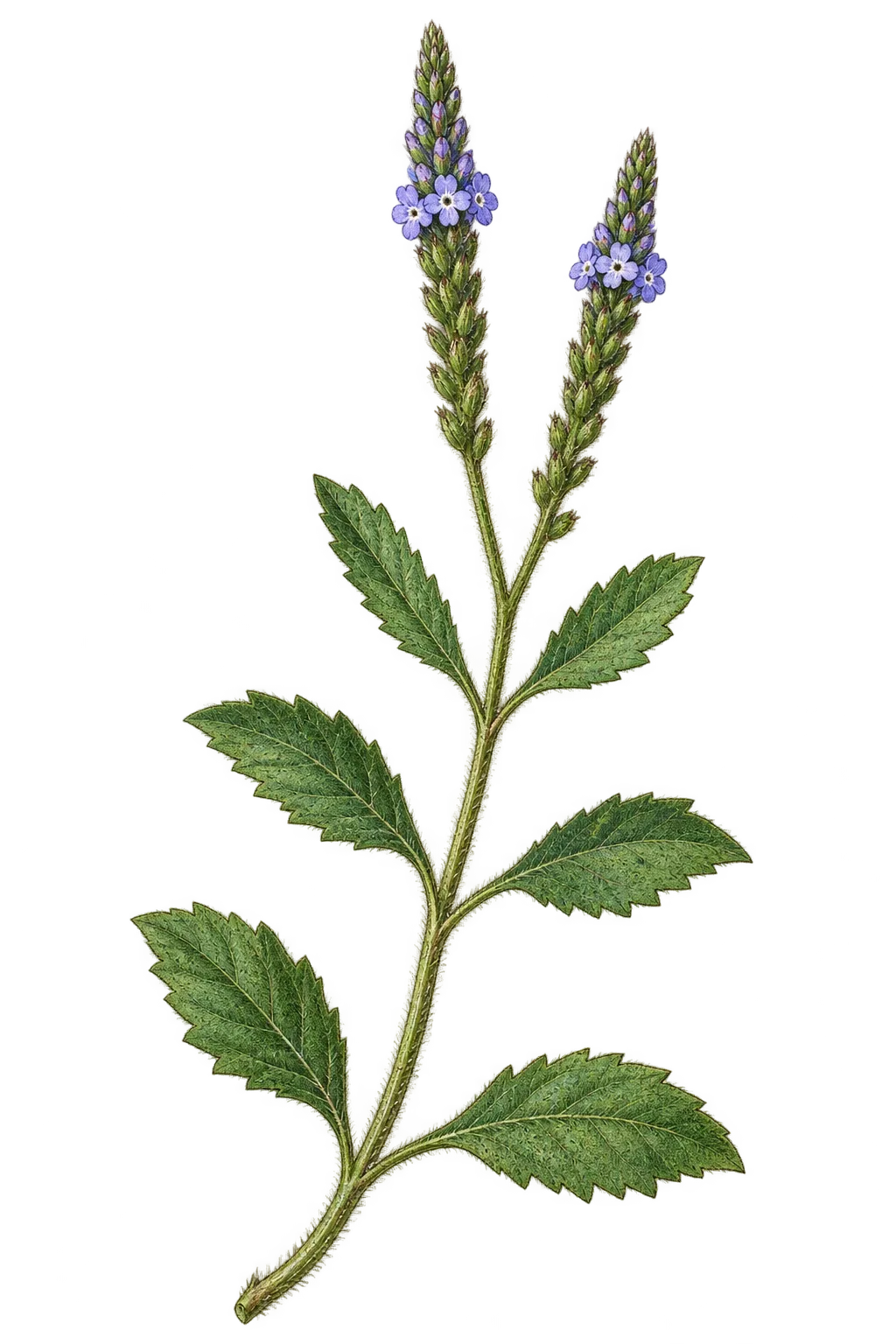
Botanical name
Kew places Verbena abramsii under V. neomexicana var. hirtella; Nesom (2010) tentatively recognises it separately near V. lasiostachys. This account follows Nesom. Kew POWO: Verbena abramsiiNesom, 2010: Is Verbena abramsii distinct from V. lasiostachys?
Recognizing the plant
Nesom describes hairy, spoon-shaped to narrow-oblong leaves with coarse teeth. Tiny purple or blue flowers have white throats and gather along slender spikes. Their expanded faces measure only two to three millimetres across. The calyx is roughly two millimetres long, with shallow triangular lobes. As fruits develop, the spikes remain fairly compact, with adjacent fruits slightly overlapping. Nesom, 2010: Is Verbena abramsii distinct from V. lasiostachys?
Bloom window
California, following Nesom’s 2010 Verbena abramsii treatment
Nesom records flowering from May through August. Nesom, 2010: Is Verbena abramsii distinct from V. lasiostachys?
Native range
Nesom’s examined material came chiefly from southern California, with an additional Monterey County collection. His treatment records stream and lake margins, marshy meadows and seepage areas, generally at 300–800 metres. The original type was collected by Edward Palmer in San Diego County in 1875. Nesom, 2010: Is Verbena abramsii distinct from V. lasiostachys?
Botanical sources
Reviewed 2026-10-11. Seasonal development varies with location and growing conditions.