schlumbergera
Schlumbergera Lem.
A genus overview; characteristics vary between its species.
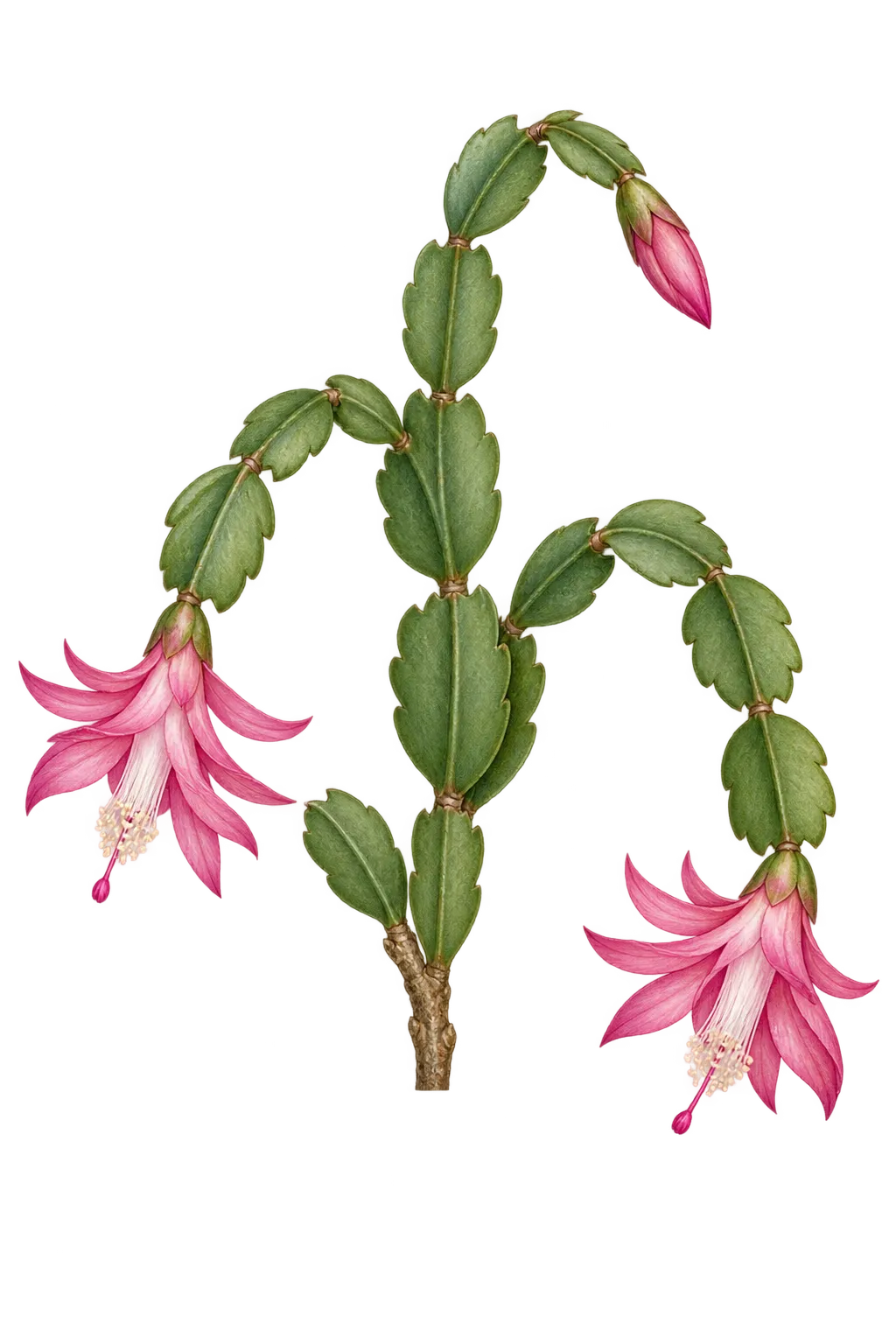
Schlumbergera belongs to a lineage of cacti associated with humid forest rather than open desert. The familiar holiday cacti grow as epiphytes, using trees as support. Their jointed growth consists of succulent stems; the flattened segments commonly cultivated are not leaves. NC State Extension: Schlumbergera
Botanical name
Schlumbergera Lem. is an accepted genus in Cactaceae. The catalog’s genus-level identity is retained rather than assigned to a holiday-cactus species or hybrid. Kew POWO: Schlumbergera
Recognizing the plant
Cultivated holiday forms often have arching or trailing stems, with scalloped or toothed segment margins and flowers produced at their tips. Bright pink, red, orange or white floral parts are tepals. The genus has more structural variety than these houseplants suggest: a botanical study distinguishes S. opuntioides and S. microsphaerica by cylindrical or compressed joints with areoles spread over their surfaces. NC State Extension: SchlumbergeraKorotkova and colleagues, 2011: Molecular markers in epiphytic Rhipsalideae
Seasonality across the genus
Northern Hemisphere indoor cultivation
The extension account describes holiday forms responding to long, uninterrupted nights and commonly flowering in November–December. This is a cultivation pattern, not a universal Brazilian flowering calendar. NC State Extension: Schlumbergera
Native range
Kew restricts the genus’s native distribution to southeastern Brazil. Its forest epiphytes require different growing conditions from desert cacti. Kew POWO: SchlumbergeraNC State Extension: Schlumbergera
Ecological relationships
The extension account records hummingbirds taking nectar and birds eating the fleshy fruits. NC State Extension: Schlumbergera
Botanical sources
- Kew POWO: Schlumbergera
- NC State Extension: Schlumbergera
- Korotkova and colleagues, 2011: Molecular markers in epiphytic Rhipsalideae
Reviewed 2026-10-11. Seasonal development varies with location and growing conditions.