setterwort
Helleborus foetidus L.
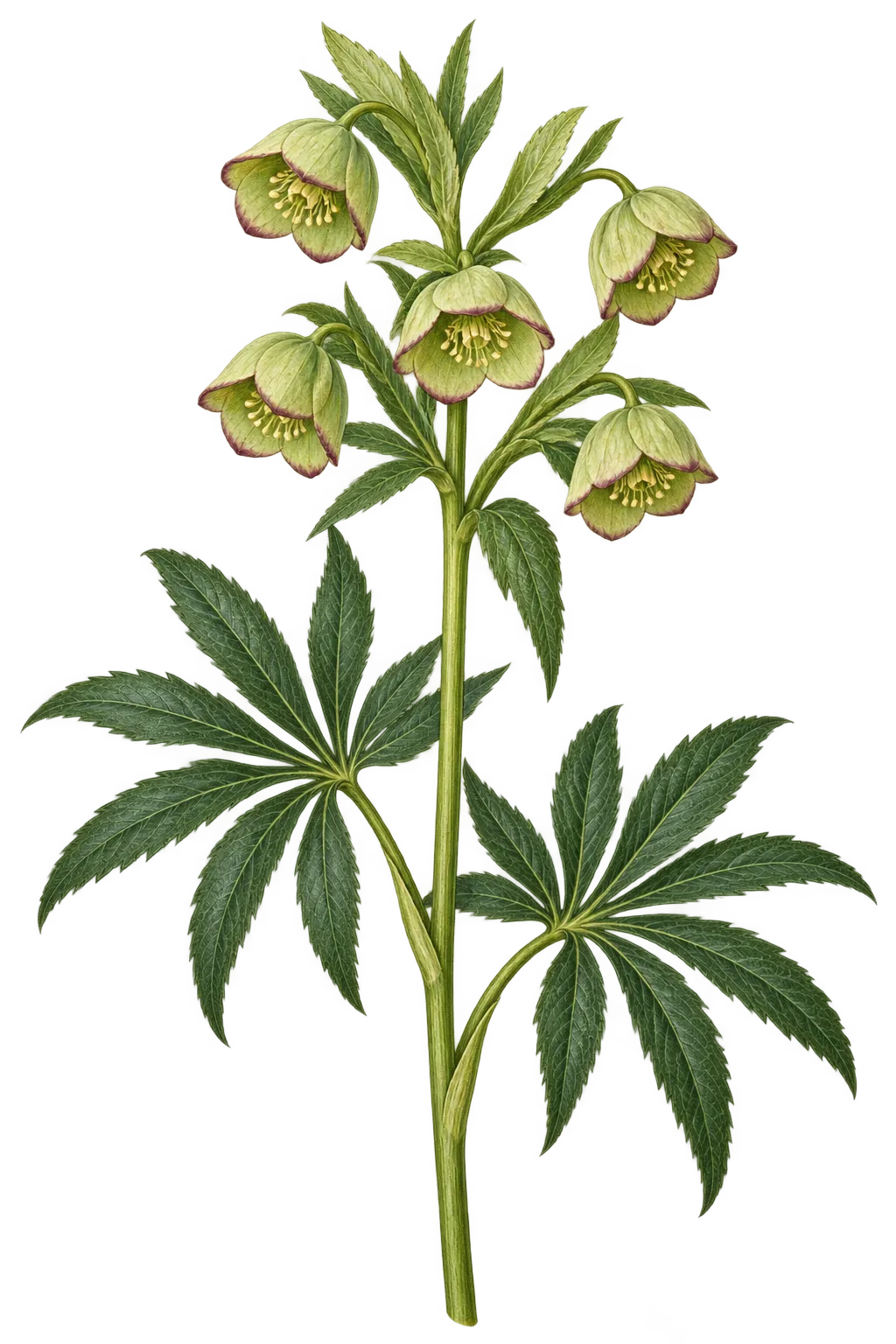
Setterwort is also known as stinking hellebore. Its flowering stems retain an abundance of leaves, and the lower foliage can persist through winter. The Swiss flora describes branching plants thirty to sixty centimetres high, carrying many nodding flowers rather than a single bloom close to the ground. Kew POWO: Helleborus foetidusInfo Flora: Helleborus foetidus, Flora Helvetica 2018
Botanical name
Helleborus foetidus L. is accepted by Kew in Ranunculaceae, matching the catalog species. Kew POWO: Helleborus foetidus
Recognizing the plant
Leaf form changes up the stem. Lower leaves divide into several narrow sections, middle leaves divide mainly toward their tips, and the highest leaves are simple and oval. Five green sepals form the flower’s outer bell, often edged in red. Inside sit funnel-shaped nectar-bearing petals, numerous stamens and several separate ovaries. The showy outer structures are therefore sepals rather than ordinary petals. Info Flora: Helleborus foetidus, Flora Helvetica 2018
Bloom window
Switzerland
The Swiss flora records flowering in March and April. Info Flora: Helleborus foetidus, Flora Helvetica 2018
Native range
Its native range extends from western Europe to central Germany and southern Italy, with populations in northern Morocco. In Switzerland it grows in woodland and on scrubby limestone slopes from low elevations into the montane belt. Kew POWO: Helleborus foetidusInfo Flora: Helleborus foetidus, Flora Helvetica 2018
Ecological relationships
Field studies in Iberia found bumblebees to be its principal pollinators, especially Bombus pratorum and B. terrestris. Herrera and colleagues 2002: Pollinators of Helleborus foetidus
Botanical sources
- Kew POWO: Helleborus foetidus
- Info Flora: Helleborus foetidus, Flora Helvetica 2018
- Herrera and colleagues 2002: Pollinators of Helleborus foetidus
Reviewed 2026-10-11. Seasonal development varies with location and growing conditions.