shrubby Indian mallow
Abutilon abutiloides (Jacq.) Garcke ex Hochr.
Abutilon abutiloides is a shrubby member of the mallow family. Kew places it chiefly in the seasonally dry tropical biome. Its identity is distinct from Abutilon californicum and A. berlandieri, two names with which it has sometimes been confused. Kew POWO: Abutilon abutiloidesFlora of North America: Abutilon abutiloides
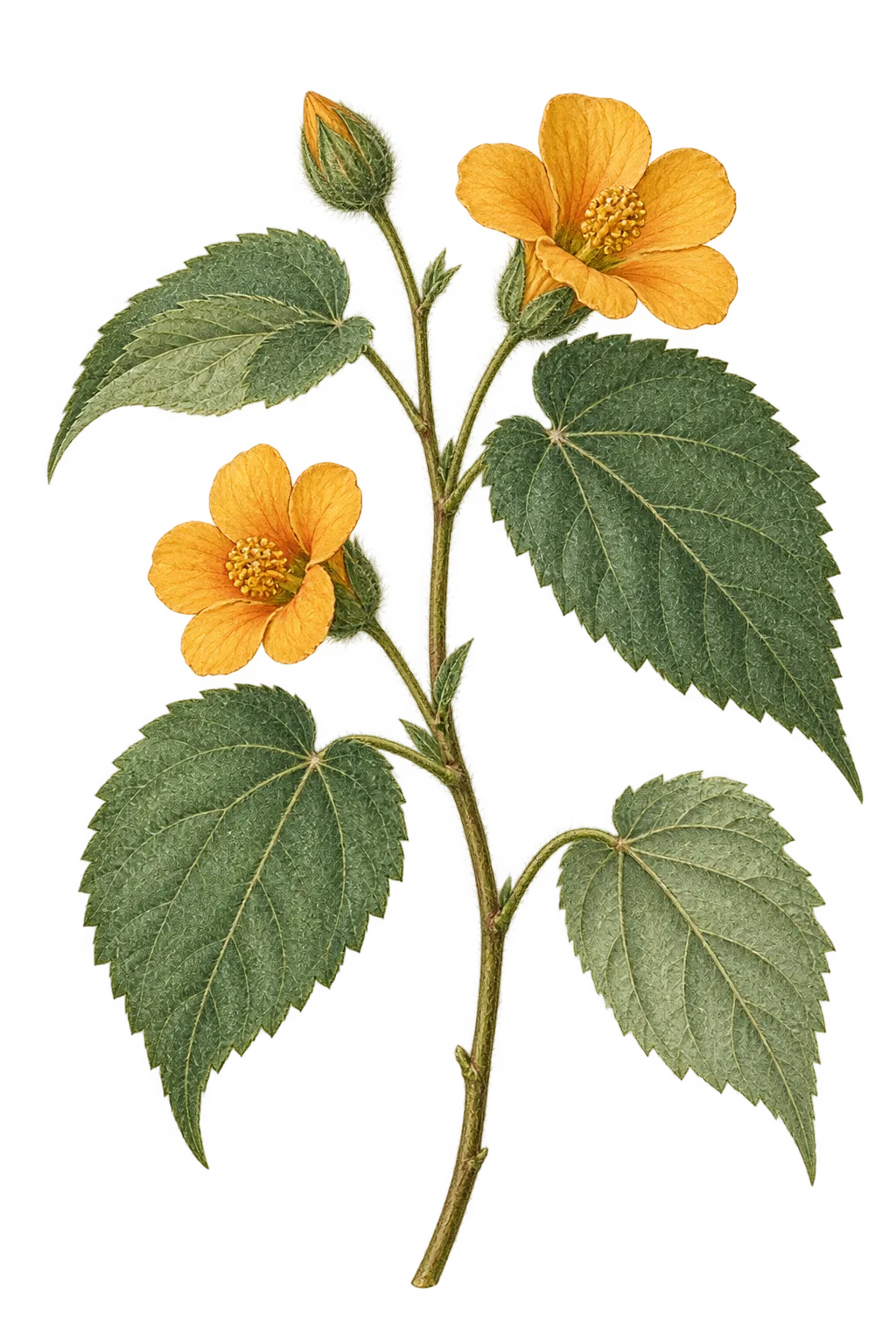
Botanical name
Kew accepts Abutilon abutiloides with the catalog’s author citation; Abutilon lignosum is a synonym. Kew POWO: Abutilon abutiloides
Recognizing the plant
The upright subshrub can reach about 1.5 metres. Rough, star-shaped hairs cover the stems and broadly egg-shaped leaves, whose bases may be heart-shaped and whose margins are toothed. Orange-yellow petals spread into a wheel-like flower, appearing singly or in branching clusters. After flowering, rounded fruits develop as a set of adjoining compartments, each containing three seeds. The stems lack glandular hairs, and the calyx remains upright around the fruit. Flora of North America: Abutilon abutiloides
Bloom window
North American flora area
Flora of North America records flowering throughout the year in its regional account. This does not mean every individual flowers continuously. Flora of North America: Abutilon abutiloides
Native range
Its native range spans tropical and subtropical America, including Arizona and Texas, much of Mexico, Caribbean islands and parts of northern South America. Within the North American flora’s area, it inhabits open, arid ground below about 1,000 metres. Kew POWO: Abutilon abutiloidesFlora of North America: Abutilon abutiloides
Botanical sources
Reviewed 2026-10-11. Seasonal development varies with location and growing conditions.