Siberian-tea
Bergenia crassifolia (L.) Fritsch
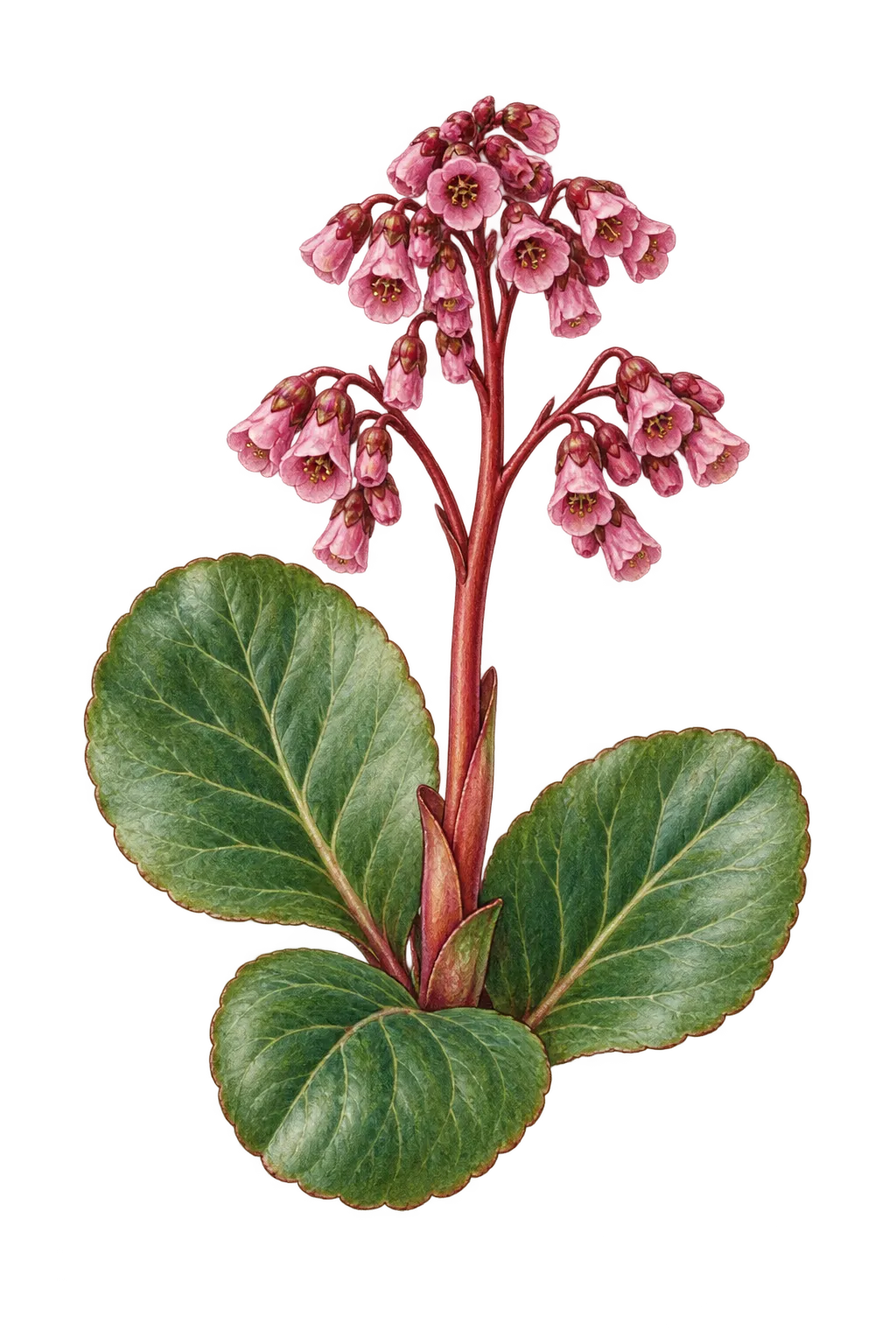
Bergenia crassifolia grows from thick, scaly rhizomes and carries its leathery leaves close to the ground. Above this substantial foliage, branching stems hold many smaller purple flowers. The contrast of broad leaves and small blossoms is characteristic of this perennial member of the saxifrage family, recorded from forest and rocky habitats across its Asian range. Kew POWO: Bergenia crassifoliaFlora of China: Bergenia crassifolia
Botanical name
The cited taxonomic authority accepts Bergenia crassifolia (L.) Fritsch at species rank. Kew POWO: Bergenia crassifolia
Recognizing the plant
The foliage gathers at the base rather than climbing the flower stems. Individual leaves range from elliptical to broader, spoon-like outlines, with blunt tips and toothed, slightly wavy margins. The flowering stems carry branched clusters of purple blossoms. Each flower has a conspicuous calyx and petals that narrow toward their bases; the developing ovary bears two styles. Fine glandular structures occur on the flower stalks and around the floral cup, adding details visible on close inspection. Flora of China: Bergenia crassifolia
Bloom window
Xinjiang, China
Flora of China places it in forests and shaded rock crevices in Xinjiang, at elevations around 1,100 to 1,800 meters, and records flowering from May through September within that treatment. Flora of China: Bergenia crassifolia
Native range
The species is native from Siberia into northern Korea, with records across parts of Mongolia, Kazakhstan and China. Kew POWO: Bergenia crassifolia
Botanical sources
Reviewed 2026-10-11. Seasonal development varies with location and growing conditions.