stapelia
Stapelia L.
A genus overview; characteristics vary between its species.
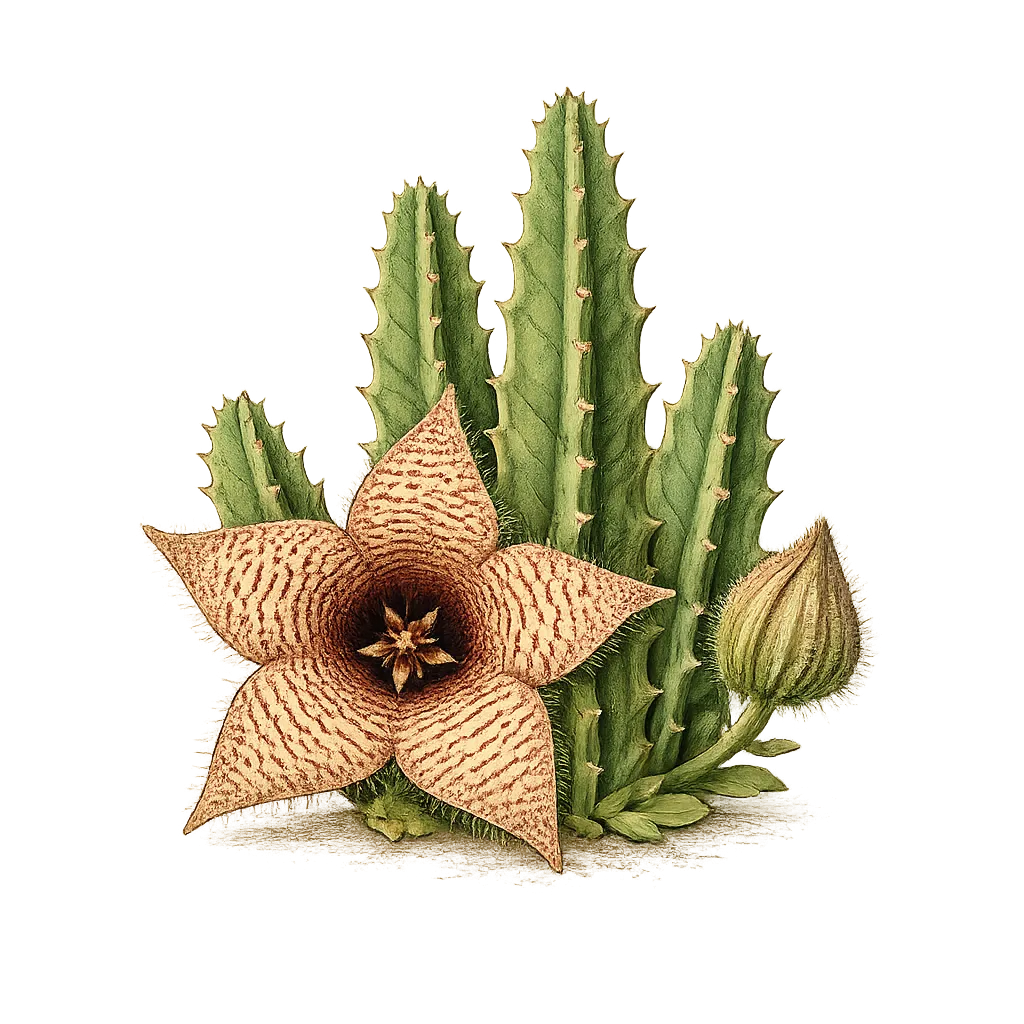
Stapelias are clump-forming succulents whose thick stems do most of the visual work. The shoots may be rounded or sharply four-angled, smooth or hairy. Their tiny leaf rudiments are short-lived. Flowers arise near the bases of the stems, sometimes singly and sometimes several together. Kew: Stapelia, Flora Zambesiaca and Flora of Tropical East Africa
Botanical name
Stapelia L. is an accepted genus in Apocynaceae. This profile retains the genus; the seasonal example names Stapelia leendertziae specifically. Kew: Stapelia, Flora Zambesiaca and Flora of Tropical East Africa
Recognizing the plant
The fleshy corolla spreads into a star, a shallow cup, or occasionally a bell. Its lobes may be smooth or fringed with hairs. Paired, spindle-shaped fruits develop after fertilization. Many species imitate carrion through scent, colour and texture, but sweet-scented exceptions include S. erectiflora and S. flavopurpurea. Kew: Stapelia, Flora Zambesiaca and Flora of Tropical East AfricaSANBI PlantZAfrica: Stapelia
Seasonality across the genus
South Africa; Stapelia leendertziae example
SANBI records November–January flowering for the bell-flowered species Stapelia leendertziae. SANBI PlantZAfrica: Stapelia
Native range
The genus is native to southern tropical and southern Africa. Many species occur in dry regions on well-drained ground, although the genus occupies a wide variety of habitats. Kew: Stapelia, Flora Zambesiaca and Flora of Tropical East AfricaSANBI PlantZAfrica: Stapelia
Ecological relationships
Flies pollinate many stapelias. The floral apparatus fastens paired pollen sacs to visiting insects, which can carry them to another flower. SANBI PlantZAfrica: Stapelia
Botanical sources
Reviewed 2026-10-11. Seasonal development varies with location and growing conditions.