stinking roger
Osteospermum calendulaceum L.f.
Stinking Roger is a low-growing, aromatic daisy that branches repeatedly from its base and along its stems. Glandular hairs give the foliage a sticky surface. The California agriculture account describes plants as annuals, with weakly rising or trailing stems reaching about sixty centimetres in length. California Department of Food and Agriculture: Osteospermum calendulaceum pest rating proposal
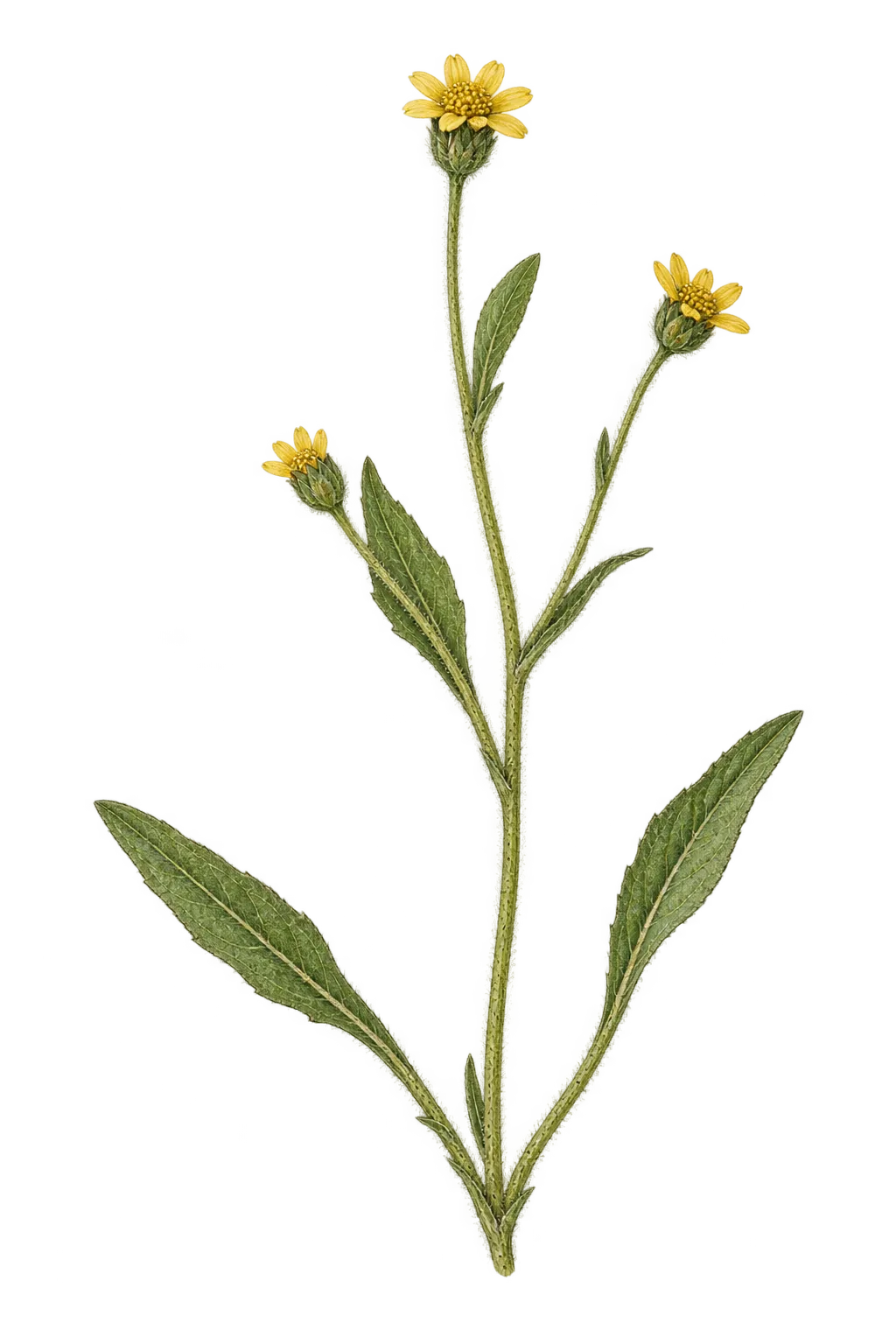
Botanical name
Kew accepts Osteospermum calendulaceum L.f.; Oligocarpus calendulaceus is a synonym. This is the catalog’s species, not another plant sharing the common name stinking Roger. Kew POWO: Osteospermum calendulaceum
Recognizing the plant
Its narrow leaves may have smooth or shallowly toothed edges and carry both glandular and ordinary hairs. Small flower heads sit singly at branch tips or in leaf axils, each with roughly six to twelve yellow ray florets. The fruits are especially distinctive: a single head can produce several shapes. Some are ridged and pitted with a hollow, cup-shaped beak; others lack those features or carry a solid horn-like beak. None has a feathery pappus. California Department of Food and Agriculture: Osteospermum calendulaceum pest rating proposal
Native range
It is native to southern Africa, including South Africa, Lesotho and Eswatini. Introduced populations occur in Australia and Hawaii. California’s first documented naturalised population was discovered in Orange County in 2022, adding another region to its history of introduction. Kew POWO: Osteospermum calendulaceumCalifornia Department of Food and Agriculture: Osteospermum calendulaceum pest rating proposal
Botanical sources
- Kew POWO: Osteospermum calendulaceum
- California Department of Food and Agriculture: Osteospermum calendulaceum pest rating proposal
Reviewed 2026-10-11. Seasonal development varies with location and growing conditions.