sweetgum
Liquidambar L.
A genus overview; characteristics vary between its species.
The sweetgum genus is broader than the familiar tree with star-shaped leaves. Molecular studies showed that trees formerly called Altingia and Semiliquidambar belong within Liquidambar, bringing tropical and subtropical relatives into the same genus. This expanded group includes trees valued for timber and fragrant resin. Ickert-Bond and Wen (2013): A taxonomic synopsis of Altingiaceae with nine new combinations
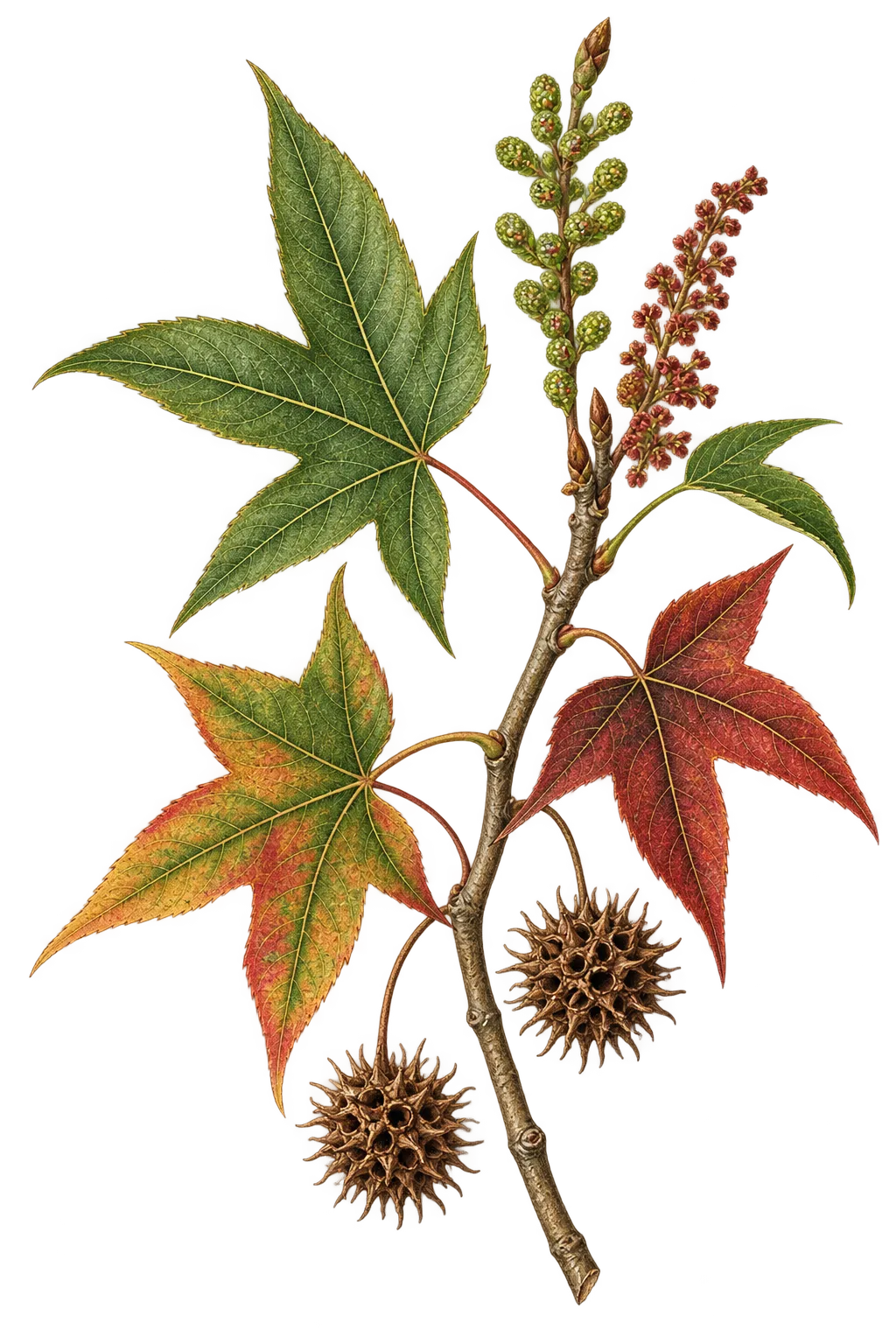
Botanical name
Liquidambar L. is accepted in Altingiaceae. Its modern circumscription includes Altingia and Semiliquidambar, whose species were formally transferred into Liquidambar in 2013. Kew Plants of the World Online: LiquidambarIckert-Bond and Wen (2013): A taxonomic synopsis of Altingiaceae with nine new combinations
Recognizing the plant
Leaf shape varies markedly. Some species have three or five spreading lobes, while others bear simple, unlobed blades with smooth or toothed edges. Even one branch can carry both lobed and unlobed leaves in certain species. The woody fruiting structures are also diverse: some are globe-shaped with conspicuous persistent styles, while others are flatter and wider toward the top. Each is a cluster of individual fruits rather than one large capsule. Male flowers are gathered into heads that are themselves arranged along elongated clusters. Ickert-Bond and Wen (2013): A taxonomic synopsis of Altingiaceae with nine new combinations
Native range
The genus has a strikingly separated native distribution. It occurs in the eastern Mediterranean, eastern and southeastern Asia through western Malesia, and the eastern United States south into Central America. Its members occupy both temperate and tropical or subtropical settings. Kew Plants of the World Online: LiquidambarIckert-Bond and Wen (2013): A taxonomic synopsis of Altingiaceae with nine new combinations
Botanical sources
- Kew Plants of the World Online: Liquidambar
- Ickert-Bond and Wen (2013): A taxonomic synopsis of Altingiaceae with nine new combinations
Reviewed 2026-10-11. Seasonal development varies with location and growing conditions.