tall globethistle
Echinops exaltatus Schrad.
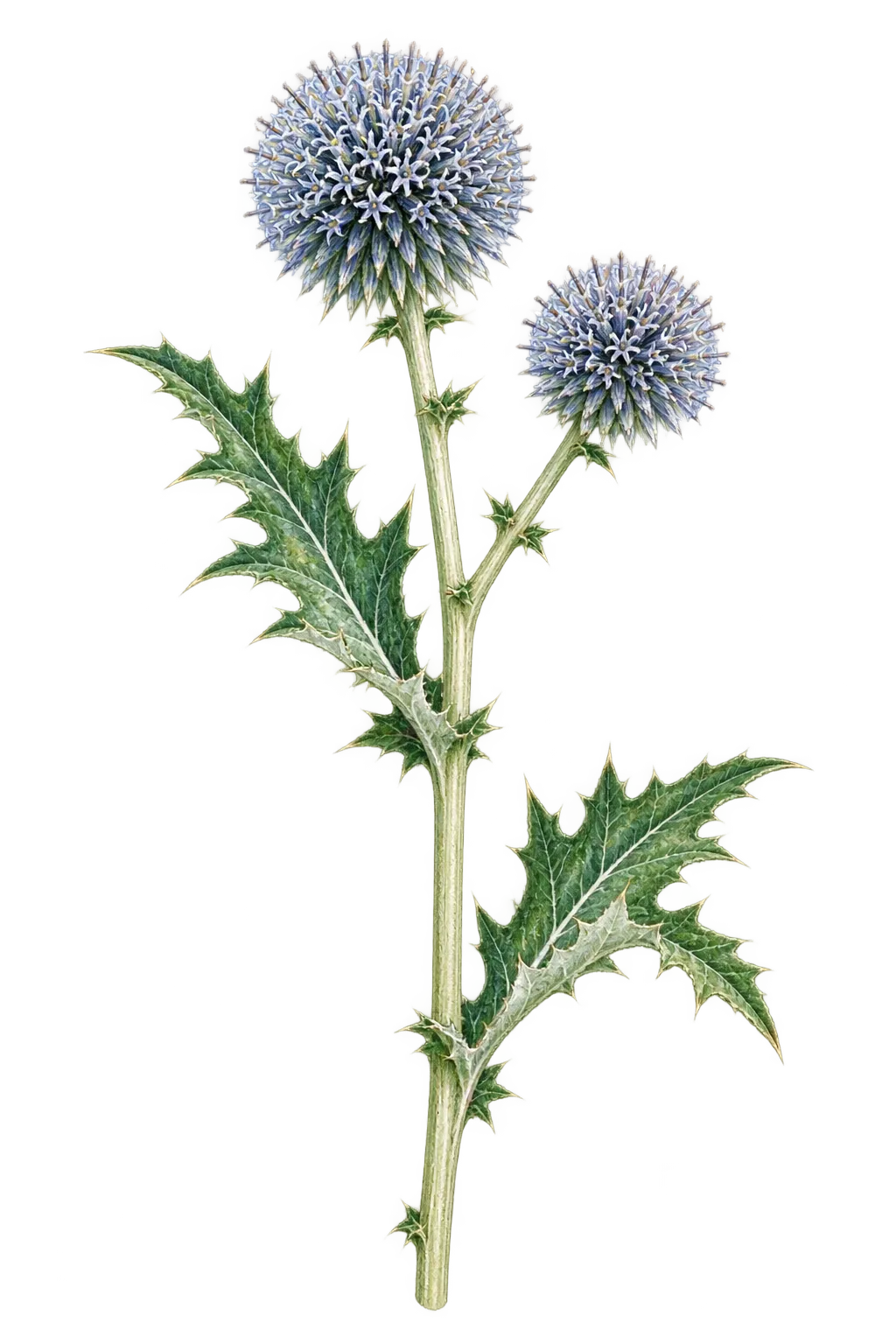
Tall globethistle is a perennial whose pale, rounded flowering clusters stand above a substantial framework of spiny foliage. Flowering stems can reach 40–150 cm and may remain simple or branch. White woolly hairs are especially conspicuous toward the upper stem. Flora of North America: Echinops exaltatus
Botanical name
Echinops exaltatus Schrad. is accepted in Asteraceae. This is the species described by Schrader, not a different name with the author Koch. Kew Plants of the World Online: Echinops exaltatus
Recognizing the plant
The leaves are divided once or twice into deep lobes, with green upper surfaces and densely white-woolly undersides. Lower leaves have winged stalks; upper leaves clasp the stem. The spherical flowering clusters measure about 3.5–6 cm across. Within them, the individual corollas are white to pale blue and roughly 8–15 mm long. The surrounding bracts have slender, curved-back tips and fringed margins, but lack glands. After flowering, small dry fruits develop, each bearing a short crown of scales rather than a long, feathery tuft. Flora of North America: Echinops exaltatus
Bloom window
North America
The Flora of North America reports flowering from June through September in its North American treatment. Flora of North America: Echinops exaltatus
Native range
Its native range lies in Europe, from Romania toward the northern and western Balkans, with Italy and Ukraine also included by Kew. Outside that range it has escaped cultivation; North American records include disturbed ground at relatively low elevations. Kew Plants of the World Online: Echinops exaltatusFlora of North America: Echinops exaltatus
Botanical sources
Reviewed 2026-10-11. Seasonal development varies with location and growing conditions.