tubercled saltbush
Atriplex acanthocarpa (Torr.) S. Watson
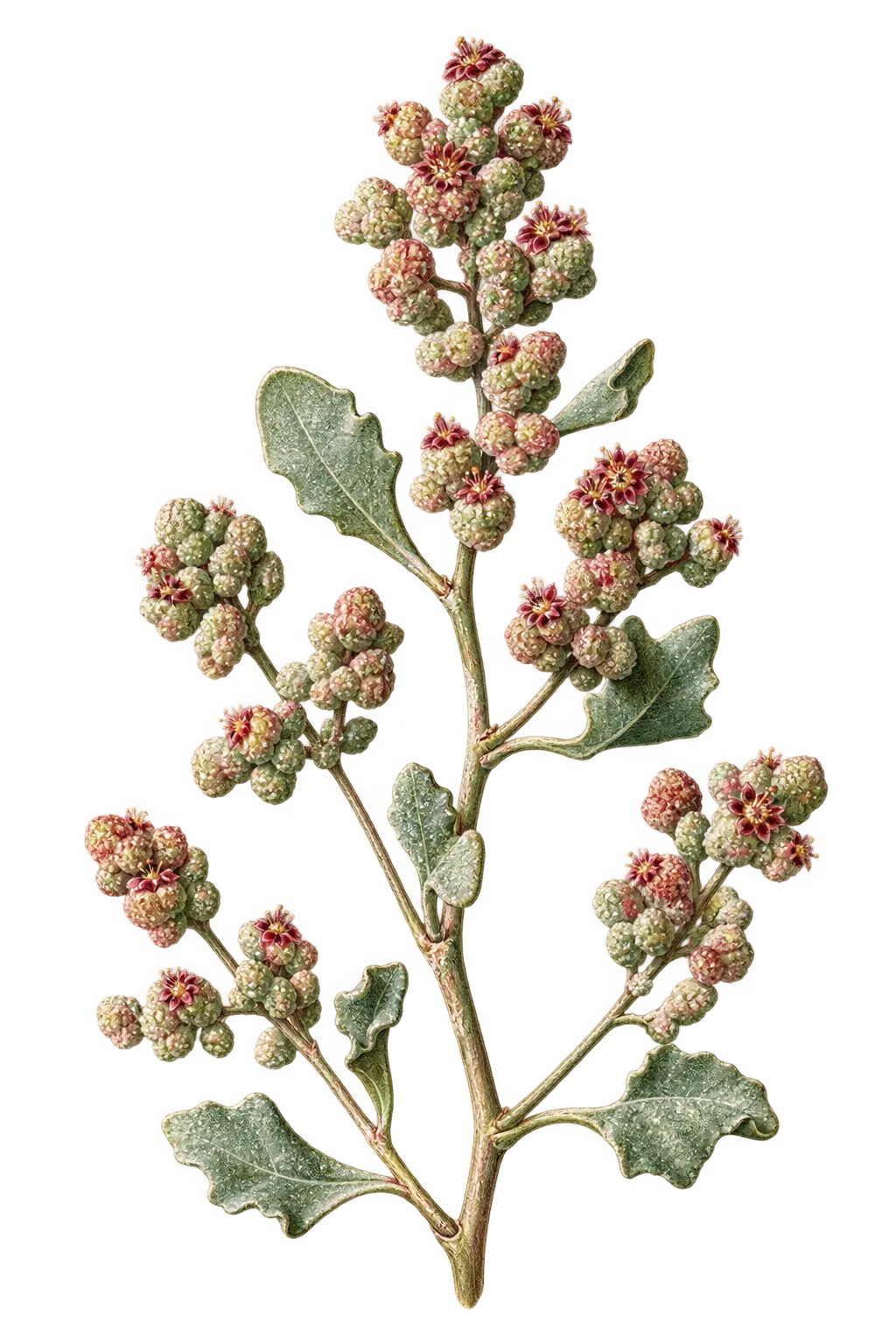
Tubercled saltbush is distinctive when its fruit develops. The enclosing structures become spongy and irregular, with flattened or hornlike projections across their surfaces. These textured coverings contrast with the small flowers that preceded them. Although the fruit coverings can look prickly, the leafy branches themselves are unarmed. World Flora Online: Atriplex acanthocarpa, Flora of North America treatment
Botanical name
The cited taxonomic authority accepts Atriplex acanthocarpa (Torr.) S. Watson at species rank. Kew POWO: Atriplex acanthocarpa
Recognizing the plant
This evergreen shrub or subshrub is woody toward the base and commonly under a metre tall. Its leaves range from oblong to broader, spoon-shaped forms and generally measure about one to four centimetres long. Lower leaves occur in opposite pairs, becoming alternate farther along the branch; their edges may be smooth or conspicuously wavy. Male and female flowers occur on separate plants. Male flowers gather in clusters along spikes, while female flowers occupy leaf axils or branching inflorescences. The mature fruit coverings may stand on short stalks or lack stalks altogether. They enclose brown seeds only about two millimetres long. World Flora Online: Atriplex acanthocarpa, Flora of North America treatment
Native range
Native from southeastern Arizona through New Mexico and western Texas into Mexico, it belongs to dry shrubland landscapes. Kew POWO: Atriplex acanthocarpa
Botanical sources
- Kew POWO: Atriplex acanthocarpa
- World Flora Online: Atriplex acanthocarpa, Flora of North America treatment
Reviewed 2026-10-11. Seasonal development varies with location and growing conditions.