tufted globe amaranth
Gomphrena caespitosa Torr.
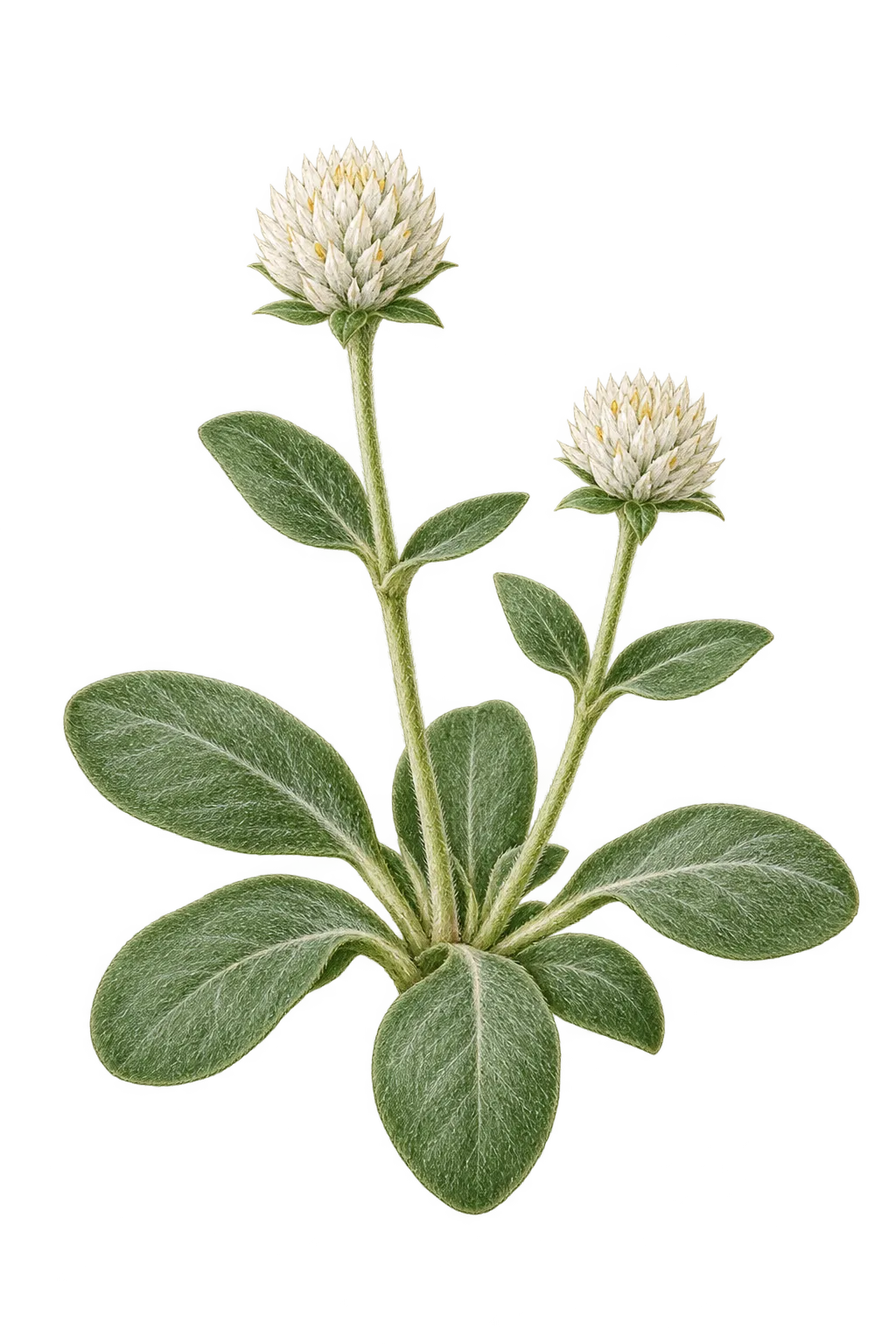
Tufted globe amaranth forms a low perennial clump, usually only 5–15 cm high. Woody roots support ascending stems above broad basal leaves. Each stem commonly carries only one or two pairs of leaves. Flora of North America: Gomphrena caespitosa
Botanical name
Gomphrena caespitosa Torr. is accepted in Amaranthaceae by ITIS and the Flora of North America. The perennial tufted species is distinct from annual globe-amaranths commonly grown in gardens. ITIS: Gomphrena caespitosa
Recognizing the plant
Leaf blades are oblong or broader toward rounded tips, 3.5–7.5 cm long. Closely pressed grayish hairs densely cover them. The white flower heads are nearly spherical and measure about 10–17 mm across. Within each head, tiny bractlets have toothed edges near their tips but lack a raised crest. Individual flowers have white-haired tubes and narrow, translucent white-to-yellow lobes. The small egg-shaped fruits are about 2 mm long, with seeds about 1.5 mm long. Flora of North America: Gomphrena caespitosa
Bloom window
Southwestern United States and Sonora, Mexico
The Flora of North America describes flowering from spring into early summer in this southwestern range. Flora of North America: Gomphrena caespitosa
Native range
The species is native to Arizona and New Mexico in the United States and Sonora in Mexico. It grows on hillsides and in open woodland, especially oak-juniper communities, at elevations of about 600–2,000 m. Flora of North America: Gomphrena caespitosa
Botanical sources
Reviewed 2026-10-11. Seasonal development varies with location and growing conditions.