watermelon
Citrullus lanatus (Thunb.) Matsum. & Nakai
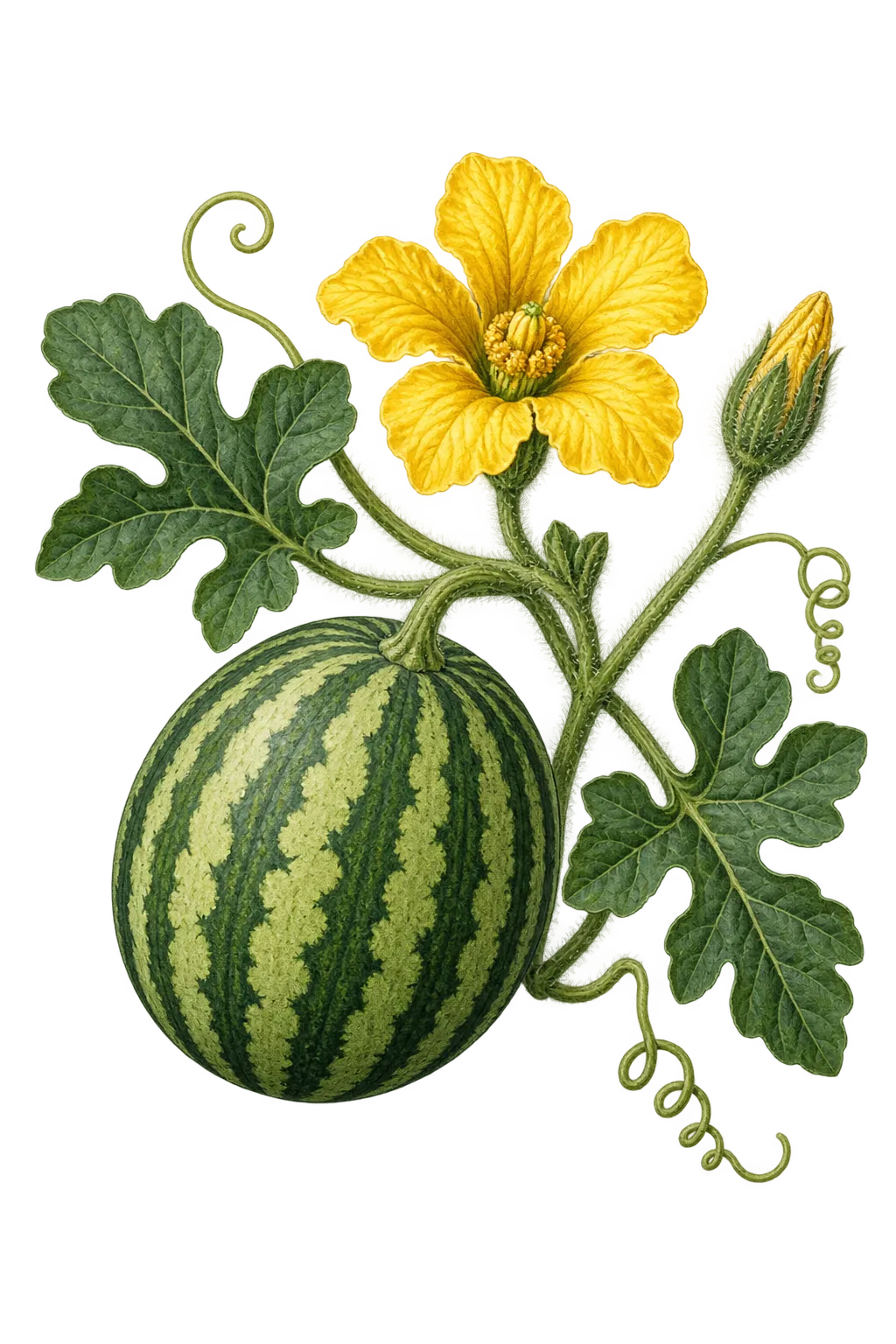
A watermelon begins with a sprawling vine and relatively small yellow flowers, a striking contrast to the heavy fruit that follows. This annual member of the cucumber family can spread several feet across the ground, using curling tendrils as it grows. NC State Extension: Watermelon
Botanical name
Kew accepts Citrullus lanatus as the watermelon species. Kew POWO: Citrullus lanatus
Recognizing the plant
Hairy stems carry deeply lobed leaves. Separate male and female flowers develop on the same plant, with individual blossoms arising in leaf axils. The rounded or oval fruit is a pepo, a modified berry with a substantial rind. Cultivated forms vary in size and flesh colour, including red, pink and yellow; the seeds may be black, cream or mottled. NC State Extension: Watermelon
Seasonal development
North Carolina horticultural account
NC State describes spring-to-summer flowers and late-summer fruit maturation, with successful growth favoured by a long, warm season. Those timings are regional and depend on planting and cultivar. NC State Extension: Watermelon
Native range
Kew places the species’ native range in the eastern Sahara, listing Egypt, Ethiopia, Libya and Sudan–South Sudan. Watermelon has since been introduced widely outside northeastern Africa and is cultivated in warm regions around the world. Kew POWO: Citrullus lanatus
Botanical sources
Reviewed 2026-10-11. Seasonal development varies with location and growing conditions.