white rattlesnakeroot
Nabalus albus (L.) Hook.
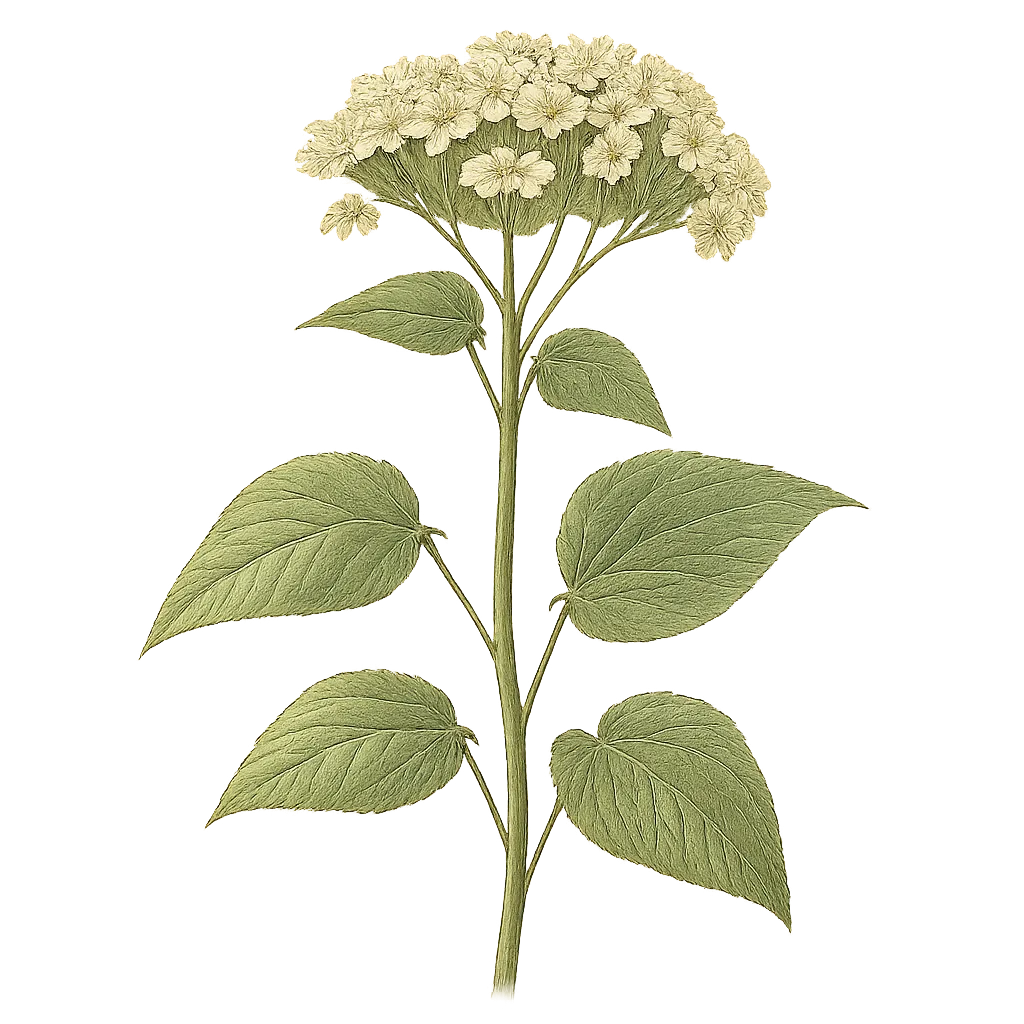
White rattlesnakeroot changes its outline as the eye moves up the stem. Large lower leaves give way to smaller upper ones beneath a branching array of pale flower heads. The broad leaves are remarkably variable: some are roughly oval or triangular, while others develop three deep lobes. Flora of North America: Prenanthes alba
Botanical name
Kew accepts Nabalus albus (L.) Hook. and lists the catalog’s Prenanthes alba L. as a homotypic synonym. Kew POWO: Nabalus albus
Recognizing the plant
Plants have a short, thickened taproot and upright stems that may be purple-mottled or nearly purple throughout. The lower leaf stalks have narrow wings. Flower heads are gathered in clusters along a branched inflorescence, with smooth purple or maroon bracts around whitish, pinkish or lavender florets. After flowering, the small brown fruits carry reddish-brown or rusty bristles, a useful identification feature alongside the foliage and stems. Flora of North America: Prenanthes alba
Bloom window
North America north of Mexico
Flora of North America records flowering in August–October, placing the pale heads in the late-summer and autumn flora. Flora of North America: Prenanthes alba
Native range
It is native across parts of central and eastern Canada and the United States, from Saskatchewan and Manitoba east to Québec and south into the eastern states. Recorded habitats include open oak–hickory woods, deciduous forest, sandy scrub, dunes, creek banks and road cuts. Kew POWO: Nabalus albusFlora of North America: Prenanthes alba
Botanical sources
Reviewed 2026-10-11. Seasonal development varies with location and growing conditions.