wisteria
Wisteria × formosa Rehder
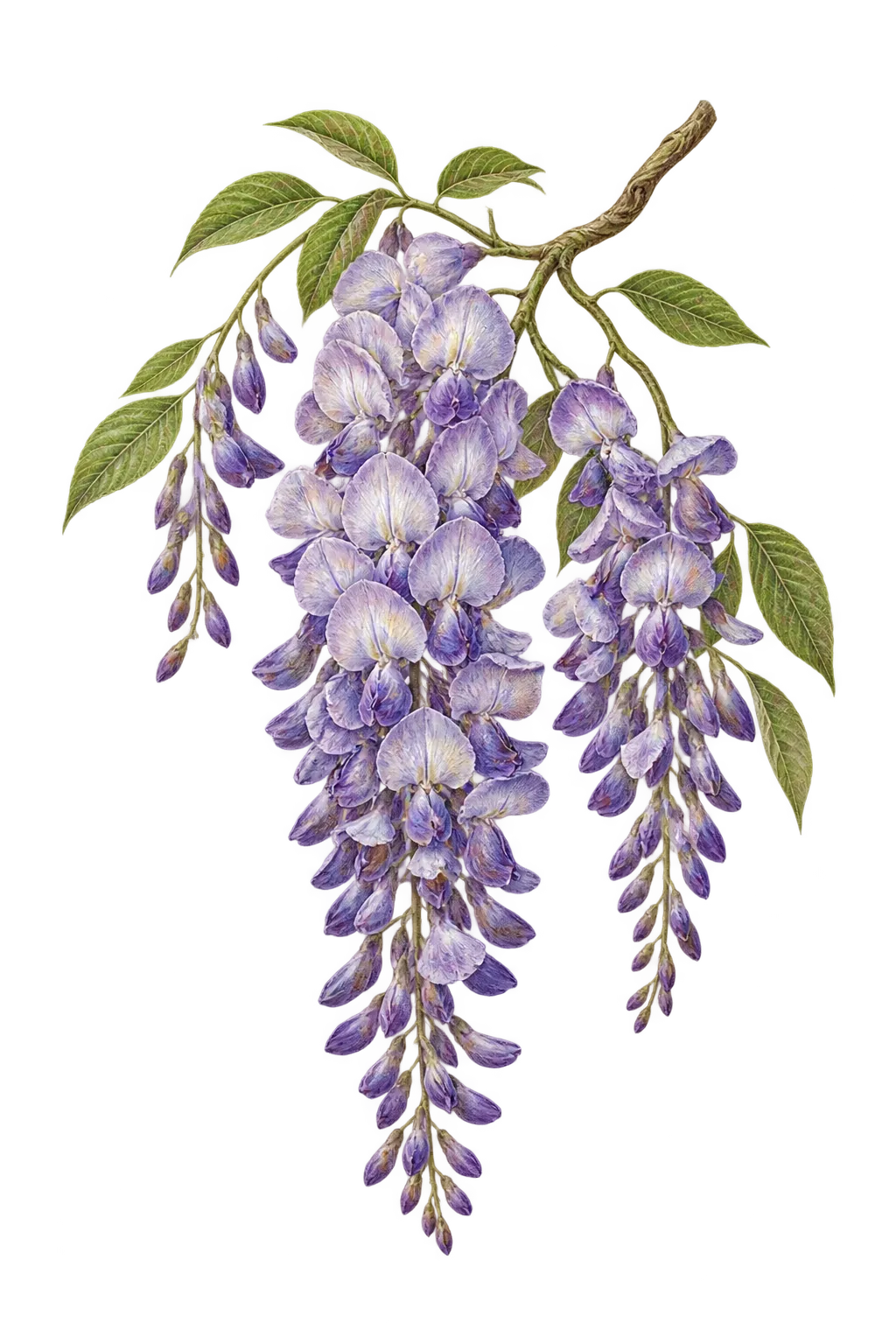
Wisteria × formosa brings together Japanese and Chinese wisterias in a cultivated hybrid. Like the Asian wisterias described by the University of Maryland, it is a deciduous perennial vine that climbs by wrapping its stems around a support. Its flower display combines a trailing cluster with unusually coordinated opening. Kew POWO: Wisteria × formosaUniversity of Maryland Extension: Chinese and Japanese WisteriaBean: Wisteria × formosa, Trees and Shrubs Online
Botanical name
Kew accepts Wisteria × formosa Rehder as an artificial hybrid between W. floribunda and W. sinensis, matching the catalog’s named hybrid. Kew POWO: Wisteria × formosa
Recognizing the plant
Bean’s account describes leaves with nine to fifteen leaflets and pale-violet flower clusters about twenty-five centimetres long. New shoots and young leaves carry silky down. As the leaves mature, both surfaces become bright green and the upper surface loses its hairs. Rehder noted that flowers within a cluster open at almost the same time, whereas Japanese wisteria typically opens its flowers progressively from the base upward. Bean: Wisteria × formosa, Trees and Shrubs Online
Bloom window
British horticultural account in Bean’s Trees and Shrubs
Bean records flowers in May and June. Bean: Wisteria × formosa, Trees and Shrubs Online
Native range
This named hybrid has a cultivated origin rather than a wild native range. It was raised in 1905 in Charles Sprague Sargent’s garden at Holm Lea, Brookline, Massachusetts, using W. sinensis and the white-flowered W. floribunda ‘Alba’. It reached Kew in 1922. Kew POWO: Wisteria × formosaBean: Wisteria × formosa, Trees and Shrubs Online
Botanical sources
- Kew POWO: Wisteria × formosa
- University of Maryland Extension: Chinese and Japanese Wisteria
- Bean: Wisteria × formosa, Trees and Shrubs Online
Reviewed 2026-10-11. Seasonal development varies with location and growing conditions.