yellow monkshood
Aconitum anthora L.
Aconitum anthora is a temperate Eurasian perennial in the buttercup family. Its yellow flowers combine a familiar monkshood outline with unusually fine leaf divisions. Austria’s Natural History Museum identifies this species as highly poisonous, so its botanical interest is something to observe rather than taste. Kew POWO: Aconitum anthoraInfo Flora: Aconitum anthora, Flora Helvetica 2018Natural History Museum Vienna: Aconitum anthora
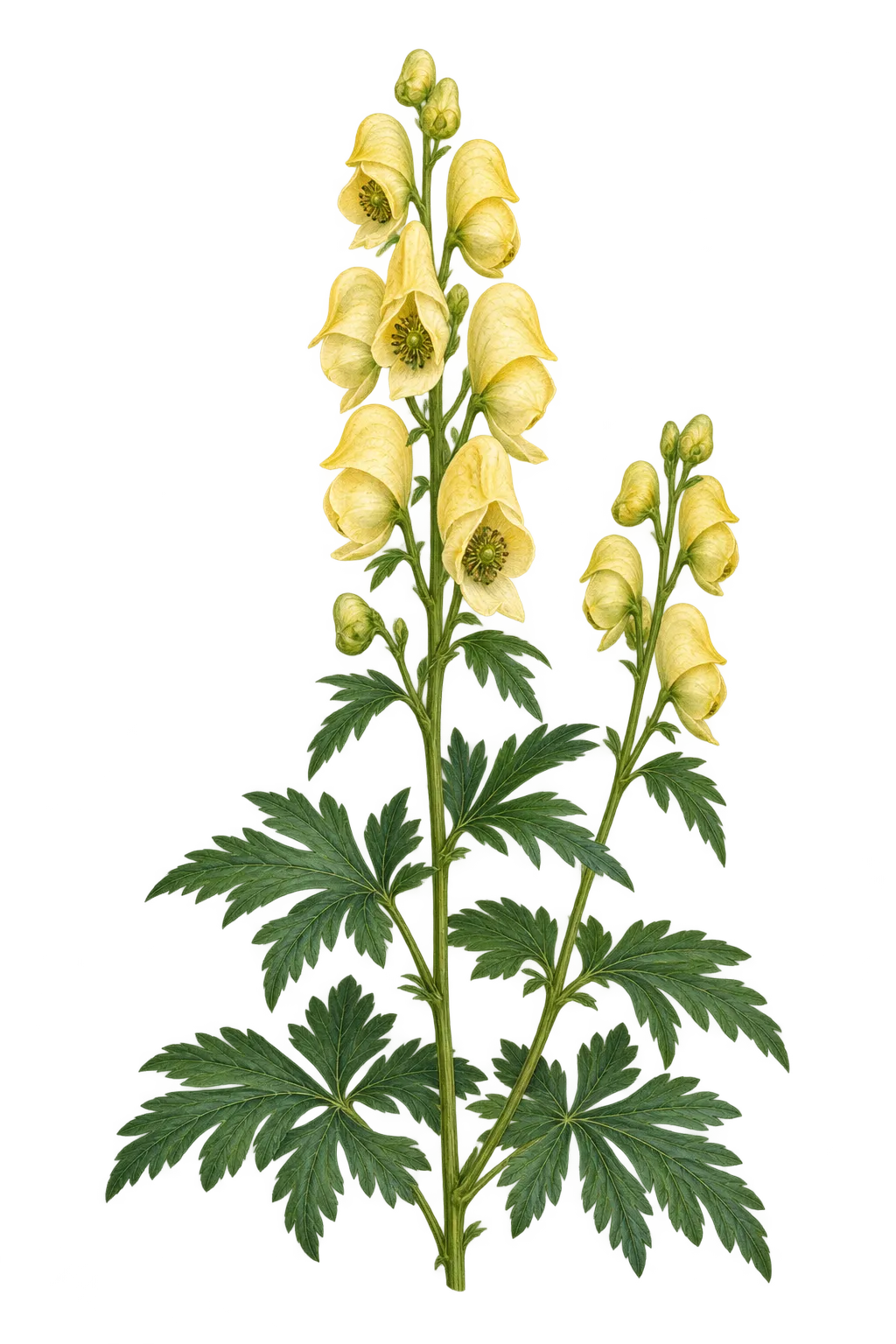
Botanical name
Aconitum anthora L. is accepted by Kew in Ranunculaceae, matching the catalog’s species identity. Kew POWO: Aconitum anthora
Recognizing the plant
The Swiss flora describes hairy plants roughly twenty to ninety centimetres tall. Leaves are divided almost to the base into five to seven sections, themselves split into very narrow lobes. Flowers gather in a dense, often unbranched cluster. The rounded upper floral part forms a helmet around two long-stalked nectar-bearing petals. After flowering, the outer floral parts persist around the developing fruits, extending the plant’s visible structure beyond the yellow display. Info Flora: Aconitum anthora, Flora Helvetica 2018
Bloom window
Switzerland
Flora Helvetica records flowering in August and September, making this a late-summer component of its Swiss mountain flora. Info Flora: Aconitum anthora, Flora Helvetica 2018
Native range
Kew records a native range stretching from Europe to Mongolia. Within Switzerland, it occupies pastures and rocky limestone slopes from the montane into the subalpine belt. Its Swiss flowering habitats therefore include both grazed mountain land and exposed rocky ground. Kew POWO: Aconitum anthoraInfo Flora: Aconitum anthora, Flora Helvetica 2018
Botanical sources
- Kew POWO: Aconitum anthora
- Info Flora: Aconitum anthora, Flora Helvetica 2018
- Natural History Museum Vienna: Aconitum anthora
Reviewed 2026-10-11. Seasonal development varies with location and growing conditions.