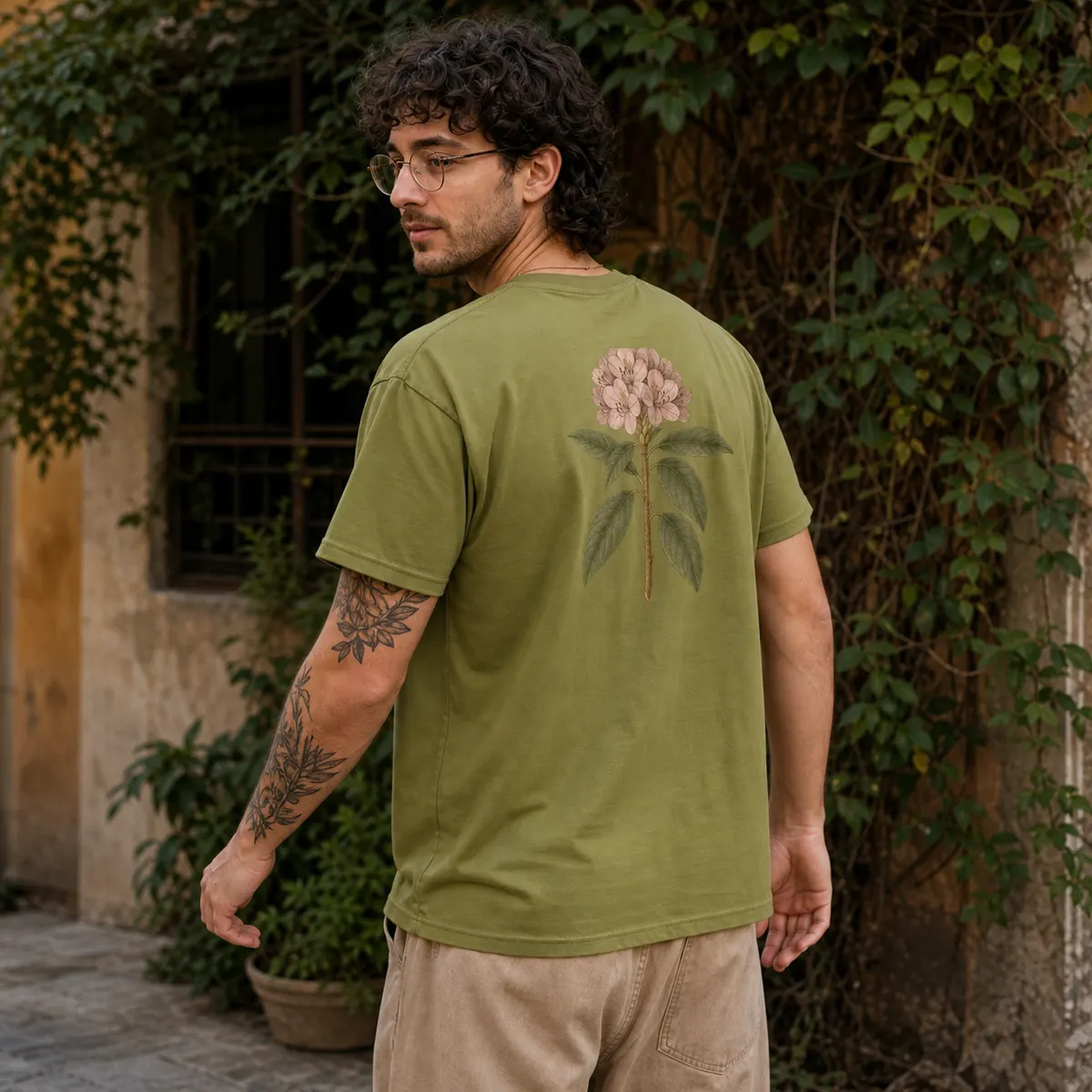
Mountain Laurel
$40.00 USD
Created in the tradition of 19th-century botanical plates, then reviewed by hand before it goes anywhere near a shirt. Yours is printed fresh when you order it.
Style: Short Sleeve
Description
This women's tee is made from 6.1 oz 100% ring-spun US cotton in a boxy, slightly cropped mid-length cut. It features a topstitched ribbed collar, shoulder-to-shoulder twill tape, a seamless body, and a double-needle bottom hem. Dyed with OEKO-TEX certified low-impact dyes in a WRAP-certified facility, using a salt-free clean pigment process that uses about half the water of conventional pigment dyeing. Boxy fit, sizes S–2XL — it runs close to the body, so size up for a looser drape. Slight shade variation between garments is normal.
Size Chart
Garment measurements in inches, laid flat.
| Size | Body length | Body width |
|---|---|---|
| S | 20" | 18 1/4" |
| M | 21" | 20 1/4" |
| L | 22" | 22" |
| XL | 23" | 24" |
| 2XL | 24" | 26" |
The blank
Shipping
Returns
Meet mountain laurel
Kalmia latifolia L.
Mountain laurel can form a lasting evergreen layer beneath eastern North American forests. Usually a shrub about 2–3 m tall, it sometimes grows much larger. A substantial basal burl and rootstock support the plant, while its thick foliage remains through winter. Showy flower clusters appear above a framework of long, narrow, ridged stems. US Forest Service FEIS: Kalmia latifolia
Bloom window
Boston, Massachusetts, cultivated plants
At the Arnold Arboretum in Boston, the flowering display is a June event. Arnold Arboretum: Late-spring finale
Native range
It ranges through eastern North America, prominently in the Appalachians, from the northeastern United States south to the Florida panhandle and west toward Louisiana. Rocky or sandy acidic ground, ridges and wooded hillsides are characteristic habitats, although some populations occupy moister, well-drained sites. US Forest Service FEIS: Kalmia latifolia
Ecological relationships
Each flower holds ten stamens under tension in tiny petal pockets. A visiting bee can release them, catapulting pollen onto its body. Arnold Arboretum: Mountain laurels fling pollen
Explore this plant's botanical story