mountain laurel
Kalmia latifolia L.
Mountain laurel can form a lasting evergreen layer beneath eastern North American forests. Usually a shrub about 2–3 m tall, it sometimes grows much larger. A substantial basal burl and rootstock support the plant, while its thick foliage remains through winter. Showy flower clusters appear above a framework of long, narrow, ridged stems. US Forest Service FEIS: Kalmia latifolia
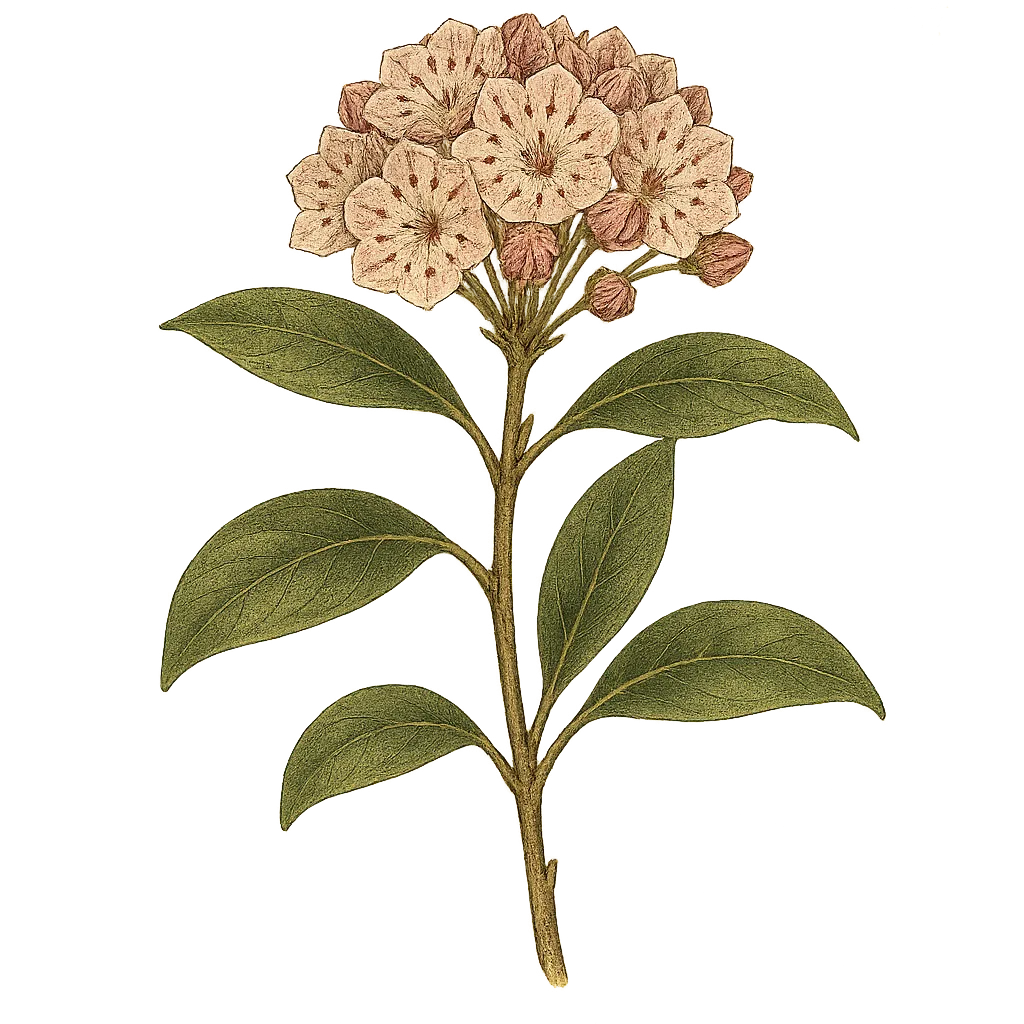
Botanical name
Kalmia latifolia is the accepted mountain-laurel species in Ericaceae, the heath family. US Forest Service FEIS: Kalmia latifolia
Recognizing the plant
The leathery leaves have an undivided blade. White to pink flowers form shallow cups or saucers, with the petals joined into one corolla. After flowering, small capsules develop, each capable of containing hundreds of minute seeds. Bark loosens in narrow flakes or strips as the stems age. US Forest Service FEIS: Kalmia latifoliaArnold Arboretum: Mountain laurels fling pollen
Bloom window
Boston, Massachusetts, cultivated plants
At the Arnold Arboretum in Boston, the flowering display is a June event. Arnold Arboretum: Late-spring finale
Native range
It ranges through eastern North America, prominently in the Appalachians, from the northeastern United States south to the Florida panhandle and west toward Louisiana. Rocky or sandy acidic ground, ridges and wooded hillsides are characteristic habitats, although some populations occupy moister, well-drained sites. US Forest Service FEIS: Kalmia latifolia
Ecological relationships
Each flower holds ten stamens under tension in tiny petal pockets. A visiting bee can release them, catapulting pollen onto its body. Arnold Arboretum: Mountain laurels fling pollen
Botanical sources
- US Forest Service FEIS: Kalmia latifolia
- Arnold Arboretum: Mountain laurels fling pollen
- Arnold Arboretum: Late-spring finale
Reviewed 2026-10-11. Seasonal development varies with location and growing conditions.