arborvitae
Thuja occidentalis L.
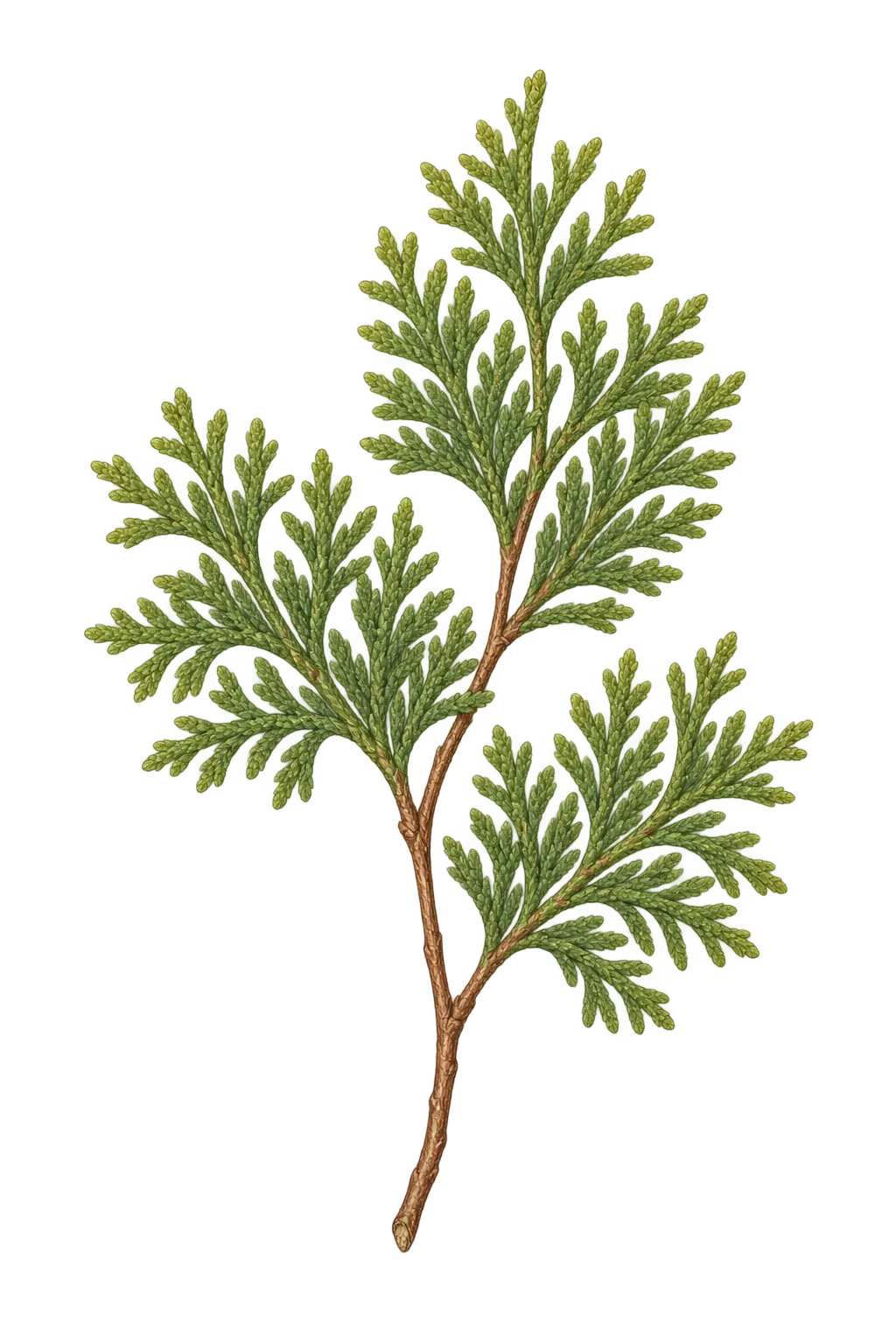
Arborvitae builds its evergreen canopy from flattened, fanlike sprays. A dominant trunk supports the crown, while cultivated forms can be pyramidal, rounded or strongly columnar. The aromatic foliage and reddish-brown bark, flaking along the trunk and branches, remain useful recognition features outside the reproductive season. NC State Extension: Thuja occidentalis
Botanical name
Kew accepts Thuja occidentalis L., a member of the cypress family, Cupressaceae. Kew Plants of the World Online: Thuja occidentalis
Recognizing the plant
The small leaves overlap like scales along the branchlets. Pollen-producing and seed-bearing structures occur on the same tree, usually on different twigs. Yellowish pollen cones and pinkish young seed cones are tiny compared with the foliage around them. Mature seed cones are oblong, pale cinnamon brown and about 8–13 mm long. Their overlapping scales open to release winged seeds that travel on the wind. NC State Extension: Thuja occidentalisUSDA Forest Service Silvics: Northern White-Cedar
Cones and seasonal development
Northern Michigan
Seed cones ripen in August and September and open soon afterward. USDA Forest Service Silvics: Northern White-Cedar
Native range
Northern white-cedar is native to central and eastern Canada and the north-central and eastern United States, with scattered Appalachian populations extending south to North Carolina and Tennessee. It inhabits wet forests and swamps as well as rocky cliffs and upland sites. Kew Plants of the World Online: Thuja occidentalisUSDA Forest Service Silvics: Northern White-Cedar
Ecological relationships
Songbirds nest in the branches, and white-tailed deer use the dense foliage for winter shelter and browse. NC State Extension: Thuja occidentalis
Its foliage supports the arborvitae leafminer, Argyresthia thuiella, whose larvae feed inside the leaves. UMass Amherst: Argyresthia thuiella
Botanical sources
- Kew Plants of the World Online: Thuja occidentalis
- NC State Extension: Thuja occidentalis
- USDA Forest Service Silvics: Northern White-Cedar
- UMass Amherst: Argyresthia thuiella
Reviewed 2026-10-11. Seasonal development varies with location and growing conditions.