auwahi melicope
Melicope adscendens (H.St.John & E.P.Hume) T.G.Hartley & B.C.Stone
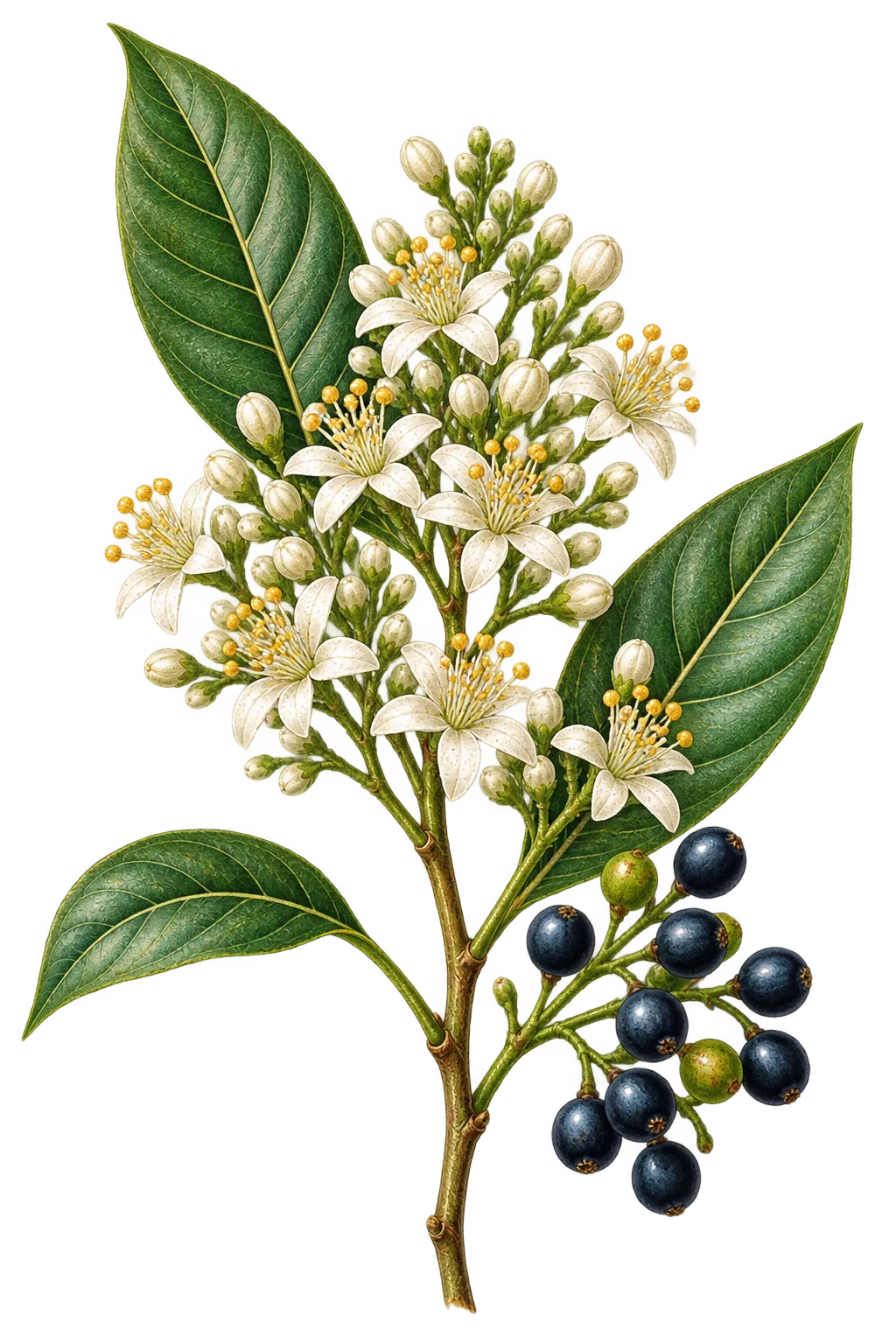
Auwahi melicope is a long-lived shrub of Maui’s forests, with slender, sprawling branches. Its young branches carry grey hairs that disappear with age. Separate fruit compartments and persistent sepals and petals help distinguish it from other melicopes. U.S. Fish and Wildlife Service: Maui and Kahoolawe critical habitat final rule, 14 May 2003
Botanical name
ITIS accepts Melicope adscendens in Rutaceae and links Pelea adscendens as its synonym. Its full author citation expands the stored Hume to E.P.Hume; both refer to the Auwahi melicope, TSN 196014. Integrated Taxonomic Information System: Melicope adscendens, TSN 196014
Recognizing the plant
The opposite leaves are elliptic, widely spaced and about 1.5–6.5 centimetres long, with hairless mature surfaces. New growth has fine yellowish to golden-brown hairs. Flower clusters contain one to three blossoms. Female flowers described in the state account have four petals, eight reduced stamens and an eight-lobed nectar disc; the fruit divides into four dry follicles. Hawaii Department of Land and Natural Resources: Alani, Melicope adscendens
Native range
This Hawaiian endemic is known from the southwestern slopes of Haleakalā on Maui. It grows in lowland mesic forest and open dry forest, often in pockets of soil among rough lava, at roughly 760–1,210 metres elevation. U.S. Fish and Wildlife Service: Maui and Kahoolawe critical habitat final rule, 14 May 2003
Ecological relationships
Forest associates include olopua, hala pepe and a‘ali‘i. Cattle trampling damages its habitat, while introduced lantana and kikuyu grass compete with the native vegetation where this shrub survives. U.S. Fish and Wildlife Service: Maui and Kahoolawe critical habitat final rule, 14 May 2003
Botanical sources
- Integrated Taxonomic Information System: Melicope adscendens, TSN 196014
- Hawaii Department of Land and Natural Resources: Alani, Melicope adscendens
- U.S. Fish and Wildlife Service: Maui and Kahoolawe critical habitat final rule, 14 May 2003
Reviewed 2026-10-11. Seasonal development varies with location and growing conditions.