blackeyed Susan
Rudbeckia hirta L.
Black-eyed Susan is a familiar pioneer of open ground, carrying bright yellow flower heads above rough, bristly foliage. Its life span varies: plants may flower as annuals, spend their first year as a leaf rosette, or persist as short-lived perennials. This flexibility helps explain its frequent use in wildflower plantings and disturbed-site revegetation. Flora of North America: Rudbeckia hirtaUSDA NRCS Plant Guide: Black-eyed Susan
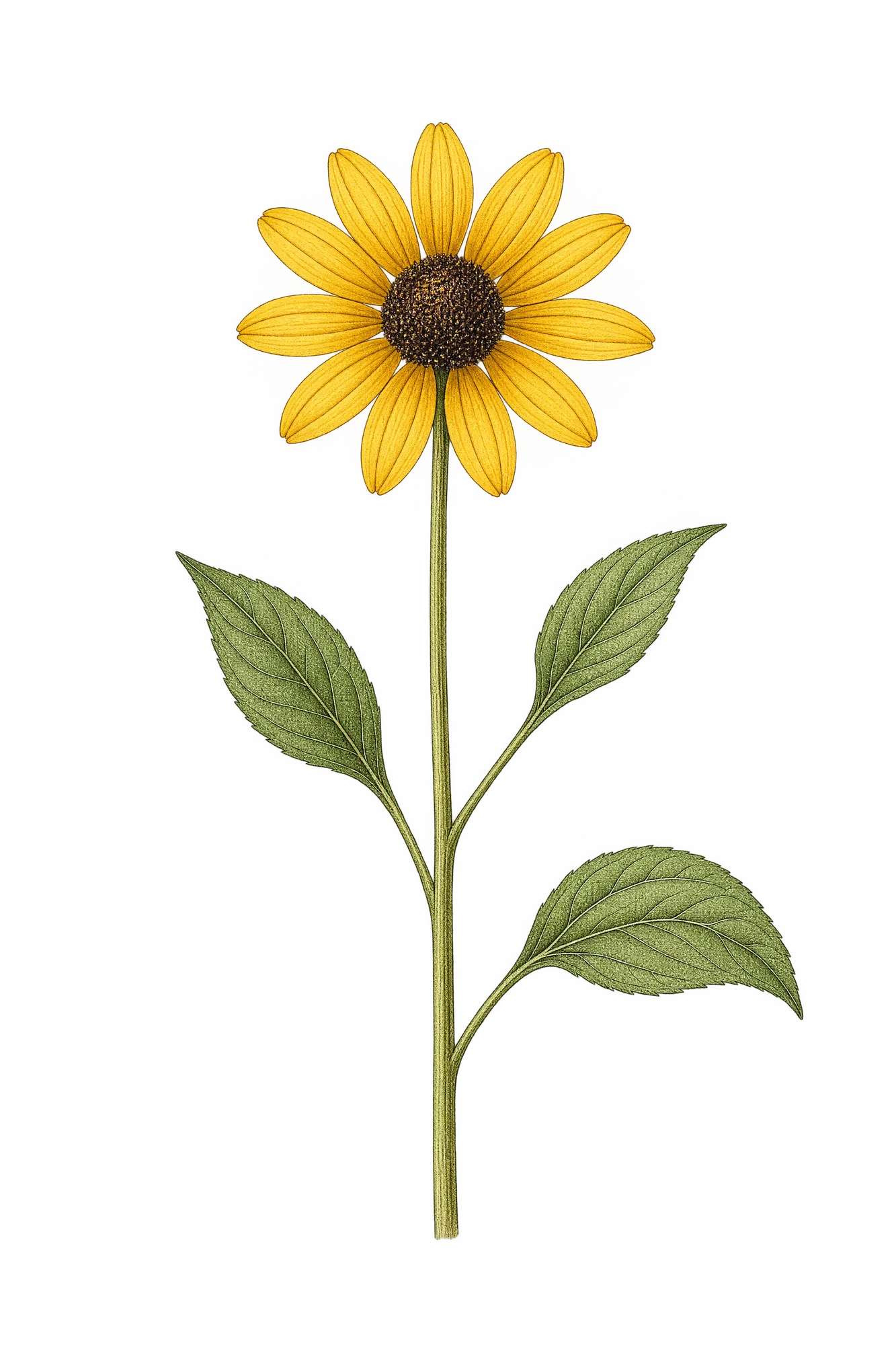
Botanical name
Rudbeckia hirta L. is accepted in Asteraceae. Its several regional varieties share the conspicuously hairy foliage described here. Kew Plants of the World Online: Rudbeckia hirta
Recognizing the plant
Spreading hairs cover both stems and leaves. The leaf blades are unlobed, ranging from narrow and lance-shaped to broadly oval, with smooth or toothed edges. Long stalks hold solitary heads or small loose groups. Usually eight to sixteen yellow or yellow-orange rays encircle a brown-purple dome packed with hundreds of tiny disc flowers. Some forms have maroon markings near the ray bases. The small dry fruits lack a feathery pappus. Flora of North America: Rudbeckia hirta
Bloom window
United States
The USDA plant guide describes summer through early-autumn flowering in the United States. USDA NRCS Plant Guide: Black-eyed Susan
Native range
The species is native to North America, with regional varieties occupying different parts of the continent. It grows in prairies, grasslands, open woodland margins and disturbed places, and has been introduced well beyond its native range. Kew Plants of the World Online: Rudbeckia hirtaUSDA NRCS Plant Guide: Black-eyed Susan
Ecological relationships
The USDA guide records this species as a food plant for silvery checkerspot and bordered patch butterfly caterpillars. USDA NRCS Plant Guide: Black-eyed Susan
Botanical sources
- Kew Plants of the World Online: Rudbeckia hirta
- Flora of North America: Rudbeckia hirta
- USDA NRCS Plant Guide: Black-eyed Susan
Reviewed 2026-10-11. Seasonal development varies with location and growing conditions.