Caribbean spiderlily
Hymenocallis caribaea (L.) Herb.
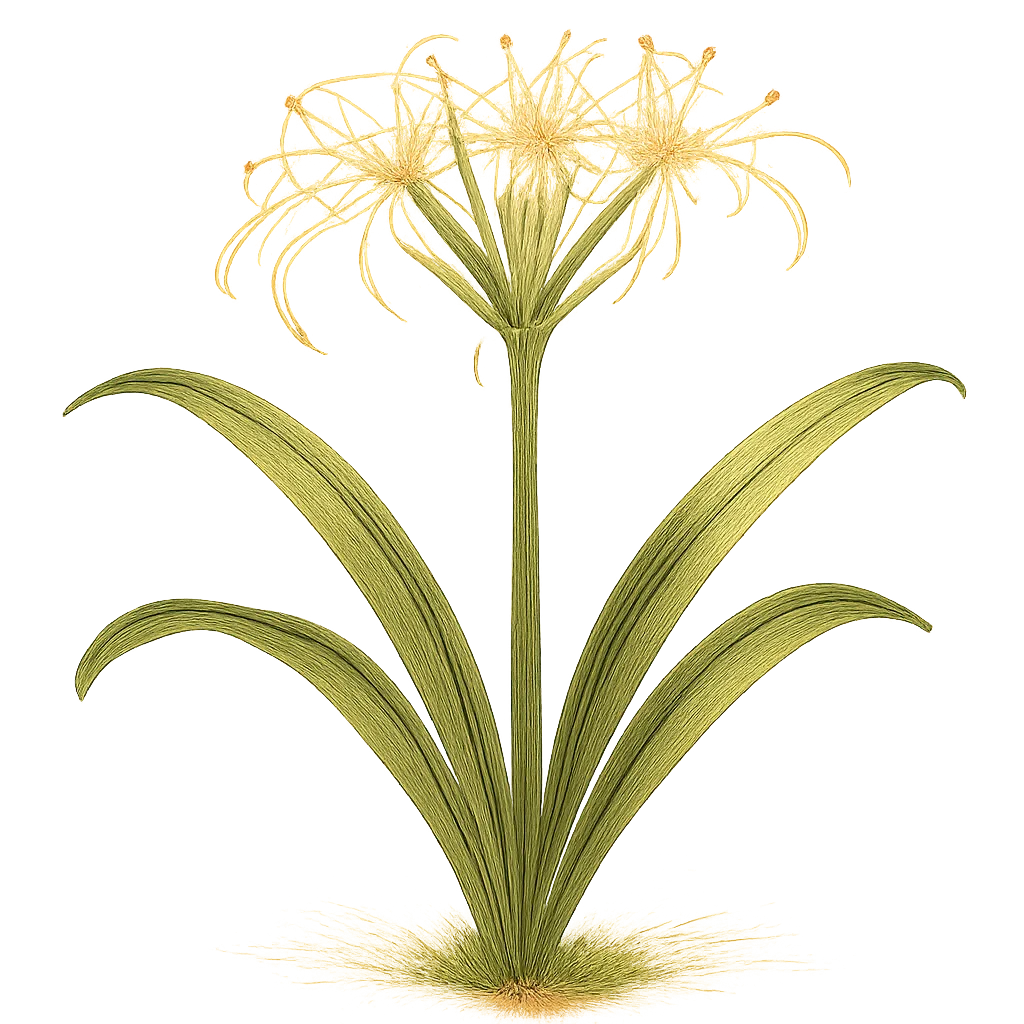
Caribbean spiderlily makes broad clumps of dark green, strap-shaped foliage punctuated by clusters of white flowers. Often planted along roadsides, this West Indian herb belongs to the amaryllis family and carries its flowers together in umbels. James Cook University: Hymenocallis caribaea
Botanical name
Kew accepts Hymenocallis caribaea (L.) Herb. in Amaryllidaceae and lists Pancratium caribaeum L. as its homotypic synonym. The manifest’s legacy Liliaceae family assignment is not followed in this account. Kew Plants of the World Online: Hymenocallis caribaea
Recognizing the plant
A substantial bulb, reaching ten centimetres across, supports spreading leaves about 30–80 centimetres long. The stout, angled flowering stalk usually remains shorter than the leaves and carries six to twelve fragrant flowers. Each has a long white tube, narrow segments that spread or curl backward, and a central cup; the fruit is a nearly spherical capsule. Royal Botanic Gardens Sydney, PlantNET: Hymenocallis caribaea
Bloom window
New South Wales, Australia
In New South Wales, flowers appear from January through March. There, naturalized plants occur on and beside the Macleay River and creeks in its lower drainage system. Royal Botanic Gardens Sydney, PlantNET: Hymenocallis caribaea
Native range
Its native Caribbean range includes Cuba, Jamaica, the Leeward and Windward Islands, and the Venezuelan Antilles. It grows primarily in seasonally dry tropical conditions, while introduced populations are recorded in places including Sri Lanka, Bermuda and New South Wales. Kew Plants of the World Online: Hymenocallis caribaea
Ecological relationships
In southern Brazilian records, Caribbean spiderlily is a food plant for caterpillars of the moth Xanthopastis timais, alongside several other members of the amaryllis family. Specht, Silva and Link (2004), Noctuídeos do Museu Entomológico Ceslau Biezanko, Revista Brasileira de Agrociência 10: 389–409
Botanical sources
- Kew Plants of the World Online: Hymenocallis caribaea
- Royal Botanic Gardens Sydney, PlantNET: Hymenocallis caribaea
- James Cook University: Hymenocallis caribaea
- Specht, Silva and Link (2004), Noctuídeos do Museu Entomológico Ceslau Biezanko, Revista Brasileira de Agrociência 10: 389–409
Reviewed 2026-10-11. Seasonal development varies with location and growing conditions.