coco yam
Colocasia esculenta (L.) Schott
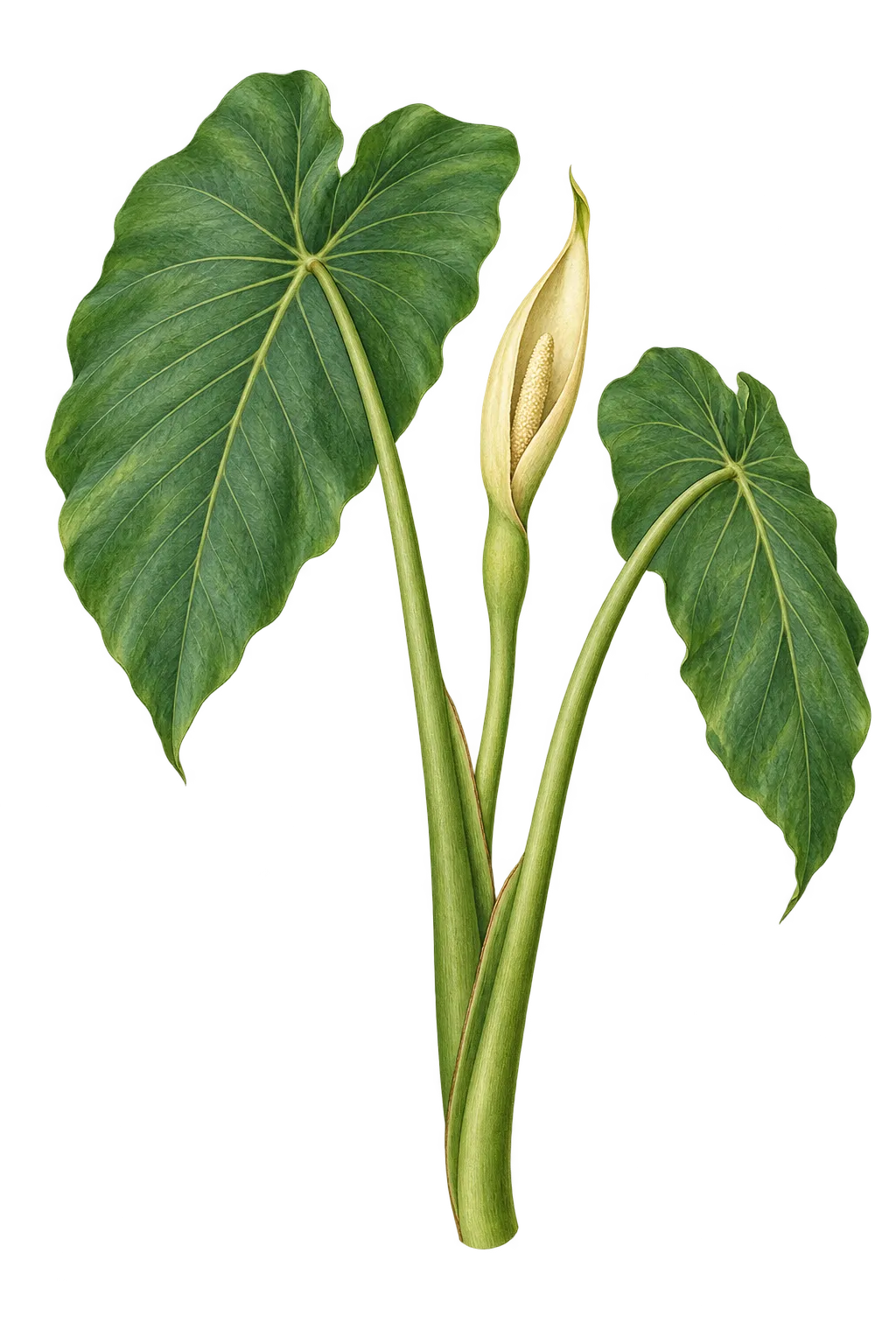
A taro leaf is attached like a shield: its stalk joins the underside inside the blade rather than simply meeting the edge. The broad, arrow-shaped blade usually droops, and its waxy surface sheds water. Together with long, substantial stalks, these leaves create the familiar elephant-ear outline. Below ground, the plant forms a swollen storage stem and, in some forms, spreading stolons. Kew CATE Araceae: Colocasia esculenta
Botanical name
Kew accepts Colocasia esculenta (L.) Schott in Araceae. Kew POWO: Colocasia esculenta
Recognizing the plant
Colocasia esculenta is a robust herb commonly around 0.8 to 1.8 metres tall in the cited aroid treatment. Its reproductive structure has a greenish to yellowish spathe enclosing a spadix. Tiny female flowers occupy the lower part of that spike, with male flowers above and a sterile section between them. Foliage and stalk colours vary among cultivated forms. Kew CATE Araceae: Colocasia esculenta
Bloom window
Yunnan and Qin Ling area, China
The cited Chinese regional account records flowering in February–April in Yunnan and August–September in the Qin Ling area. Kew CATE Araceae: Colocasia esculenta
Native range
Kew currently places the native range from India to southern China and Sumatra. Its specialist account cautions that ancient transport and cultivation obscure the original distribution; the species is now cultivated widely through the tropics. Kew POWO: Colocasia esculentaKew CATE Araceae: Colocasia esculenta
Botanical sources
Reviewed 2026-10-11. Seasonal development varies with location and growing conditions.