daisy
Tanacetum balsamita L.
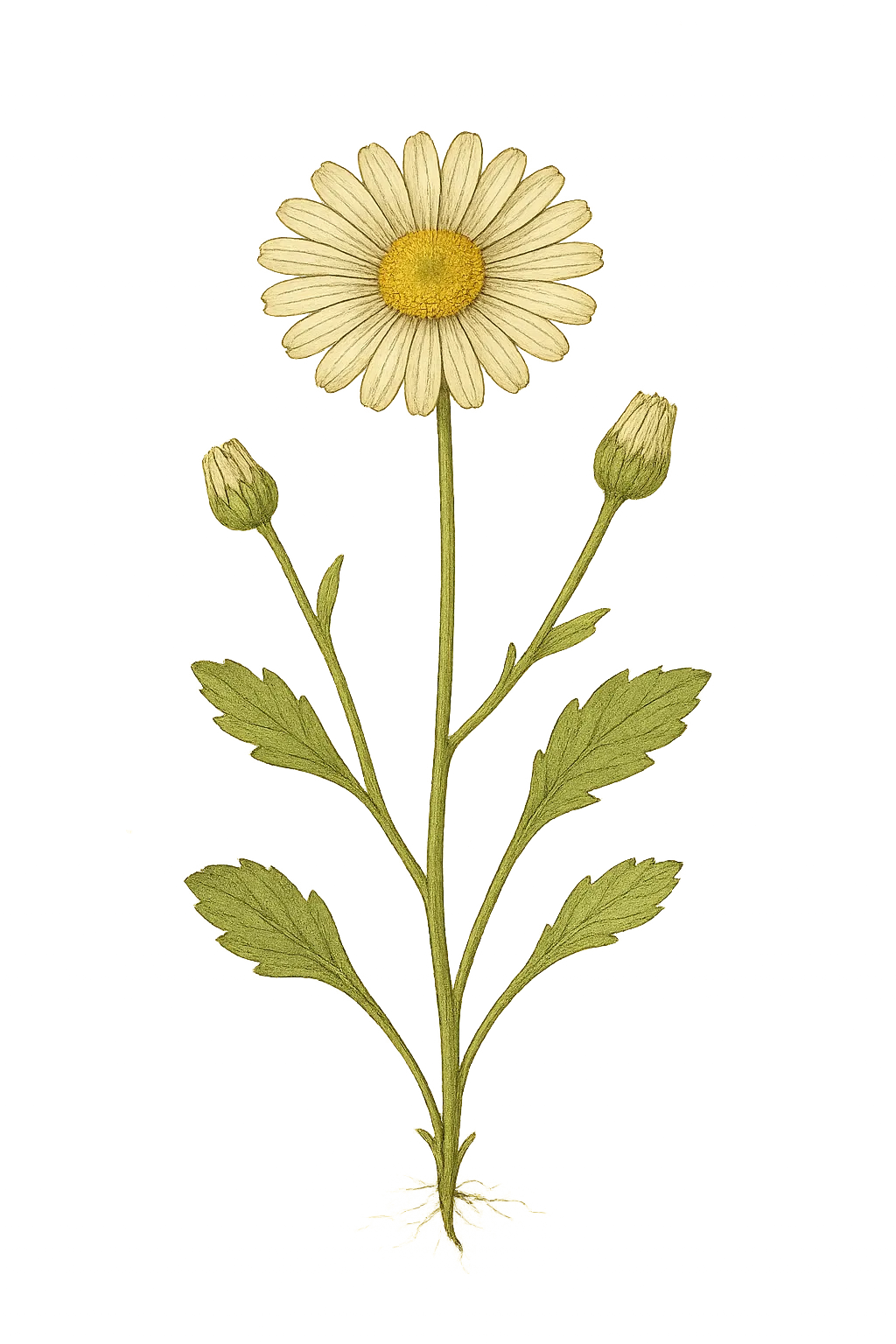
Costmary carries much of its character in its foliage. Its elongated leaves have a minty, balsamic scent, and young surfaces can look silvery with fine hairs. The plant grows upright from rhizomes, producing a leafy body beneath clusters of small yellow heads. The contrast between scented leaves and compact flower heads gives both foliage and flowering stems distinctive characters. NC State Extension: Costmary
Botanical name
Kew and USDA GRIN explicitly link the supplied Chrysanthemum majus (Desf.) Asch. to Tanacetum balsamita, costmary; the database name is retained unchanged. Kew POWO: Chrysanthemum majusUSDA GRIN: Chrysanthemum majus
Recognizing the plant
Leaves occur at the base and along the stems. The lower ones commonly have stalks, while upper leaves may attach directly to the stem. Their outlines are elliptical to oblong, with rounded teeth along the edges and sometimes a few lobes near the base. The flower heads usually lack showy rays, so the compact yellow discs give a button-like effect. Tiny, ribbed fruits carry a short crown at their tips. Flora of North America: Tanacetum balsamita
Bloom window
North America
Flora of North America records flowering in August and September for introduced populations. Flora of North America: Tanacetum balsamita
Native range
Its native range runs from the eastern Mediterranean toward Crimea and Iran. It has been introduced widely elsewhere; Flora of North America records it at disturbed sites and around abandoned plantings. Kew POWO: Tanacetum balsamitaFlora of North America: Tanacetum balsamita
Botanical sources
- Kew POWO: Chrysanthemum majus
- USDA GRIN: Chrysanthemum majus
- Kew POWO: Tanacetum balsamita
- NC State Extension: Costmary
- Flora of North America: Tanacetum balsamita
Reviewed 2026-10-11. Seasonal development varies with location and growing conditions.