eastern purple coneflower
Echinacea purpurea (L.) Moench
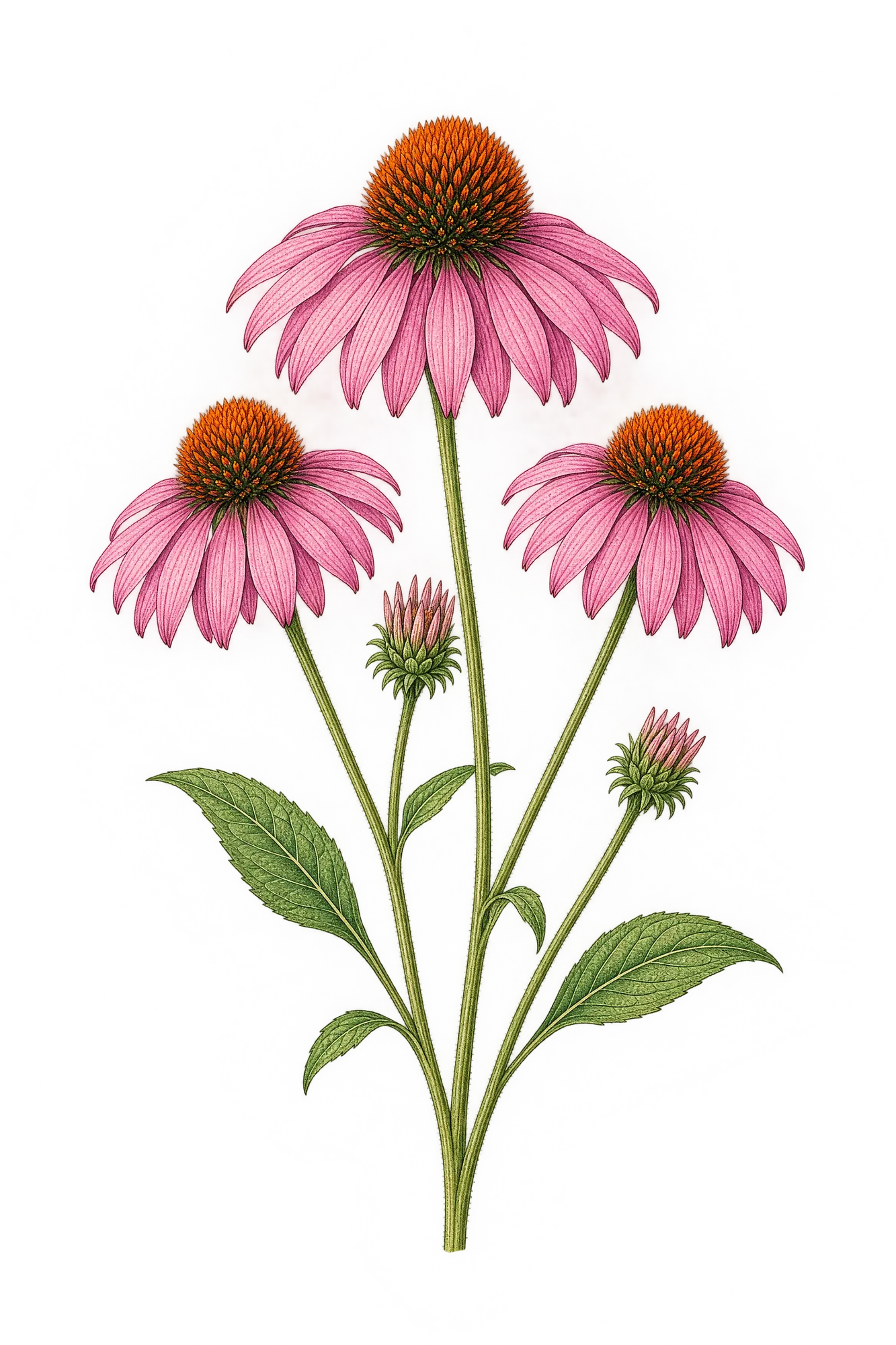
Eastern purple coneflower is a perennial of open woodland and prairie landscapes. Stiff, rough stems branch toward their tops and carry conspicuous flower heads. What looks like a single bloom is a composite structure: the long purple outer rays surround a raised central disk containing many smaller flowers. Kew Plants of the World Online: Echinacea purpurea
Botanical name
Echinacea purpurea (L.) Moench is an accepted species of Asteraceae. The profile concerns the species, rather than a named horticultural cultivar. Kew Plants of the World Online: Echinacea purpurea
Recognizing the plant
Leaves are broadly lance-shaped to oval, with rough surfaces and toothed margins. Lower leaves have winged stalks, while those higher on the stem become smaller and more nearly stalkless. The disk develops a domed, spiny-looking orange to brown center; the lavender-purple rays often slope downward around it. Flower heads can reach about 5 inches across. As they mature, the heads produce small, dark, four-sided dry fruits. NC State Extension: Echinacea purpurea
Bloom window
North Carolina, United States
In North Carolina, the main flowering period is June through August. NC State Extension: Echinacea purpurea
Native range
The species is native to the central and eastern United States. Its habitats include prairies and rocky open woods, with some populations occurring beside streams in wetter ground. Kew Plants of the World Online: Echinacea purpurea
Ecological relationships
The flower heads attract bees and butterflies. NC State Extension: Echinacea purpurea
After flowering, the seeds provide food for songbirds, including American goldfinches. NC State Extension: Echinacea purpurea
Botanical sources
Reviewed 2026-10-11. Seasonal development varies with location and growing conditions.