French hydrangea
Hydrangea macrophylla (Thunb.) Ser.
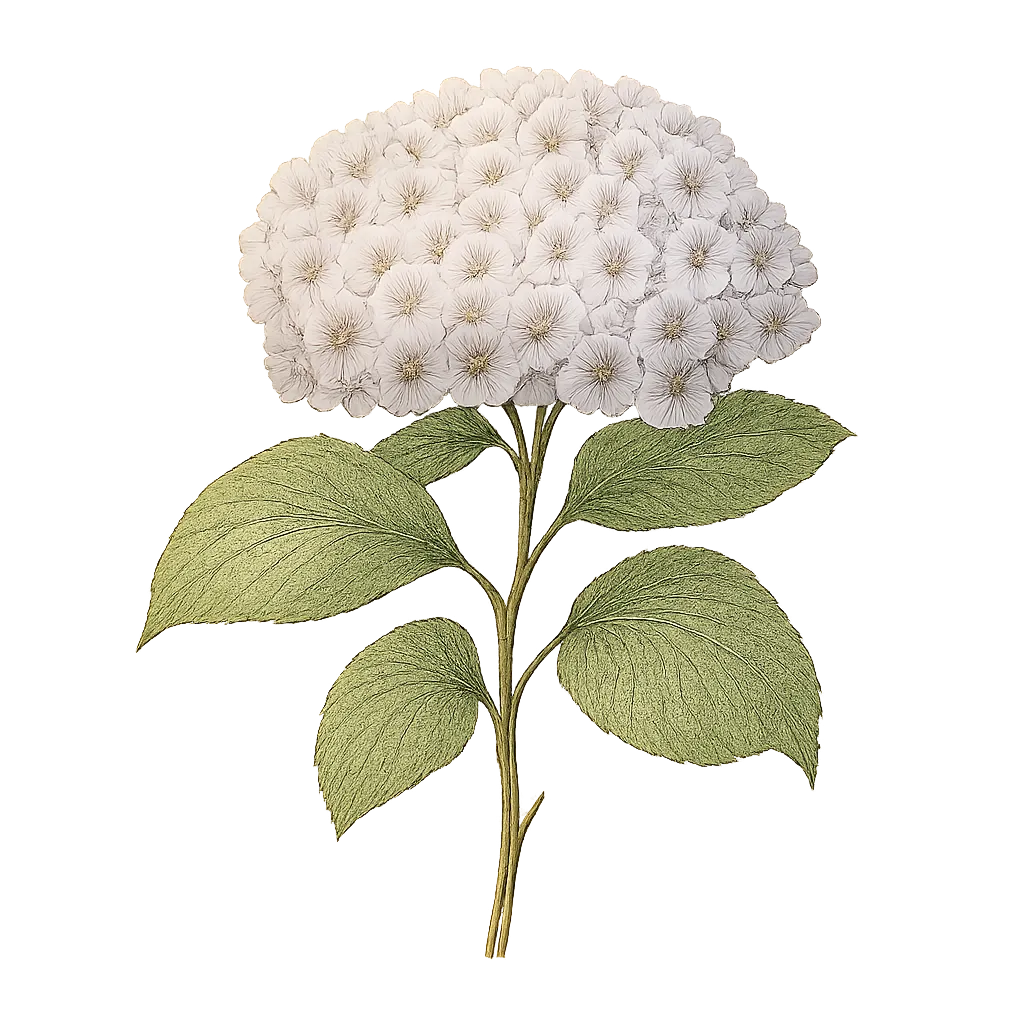
French hydrangea is a rounded, many-stemmed deciduous shrub, usually about three to six feet tall and wide in gardens. Its cultivars produce either globular mopheads or lacecaps, whose smaller central flowers are surrounded by a ring of larger blossoms. NC State Extension Gardener Plant Toolbox: Hydrangea macrophylla
Botanical name
Kew accepts Hydrangea macrophylla (Thunb.) Ser. in Hydrangeaceae. Viburnum macrophyllum Thunb. is the homotypic synonym underlying the current combination, first published by Seringe in 1830. Kew Plants of the World Online: Hydrangea macrophylla
Recognizing the plant
Broad leaves, shaped from egg-like to widest above the middle, have sharply toothed margins and may reach nineteen centimetres long. The conspicuous sterile flowers can be white, blue, purple or pink. Small capsules taper into a conical tip and enclose tiny seeds. Royal Botanic Gardens Victoria, VicFlora: Hydrangea macrophylla
Bloom window
North Carolina, United States, garden conditions
In North Carolina gardens, flowering is typically in late spring and summer on the previous year’s stems. Reblooming cultivars can make another flush later in summer on new growth. NC State Extension Gardener Plant Toolbox: Hydrangea macrophylla
Native range
The wild species is native to south-central Japan, extending to Izu Ōshima, and to the Kazan Islands. Introduced populations occur far beyond that range, including parts of Europe, China, Korea and New Zealand. Kew Plants of the World Online: Hydrangea macrophylla
Ecological relationships
Non-double lacecap forms attract bees, butterflies, flies and wasps to their flower heads. University of Wisconsin Extension: What’s All the Buzz? Woody Plants for Bees, Butterflies, and Other Bee-t-full Pollinators
Dead, hollow stems can also provide nesting places for native bees after the living shoots have finished their growth. NC State Extension Gardener Plant Toolbox: Hydrangea macrophylla
A growing note
Choose moist, well-drained ground with dappled light or partial shade, protecting the foliage from strong afternoon sun. Layering and stem cuttings are useful ways to propagate it. NC State Extension Gardener Plant Toolbox: Hydrangea macrophylla
Botanical sources
- Kew Plants of the World Online: Hydrangea macrophylla
- NC State Extension Gardener Plant Toolbox: Hydrangea macrophylla
- Royal Botanic Gardens Victoria, VicFlora: Hydrangea macrophylla
- University of Wisconsin Extension: What’s All the Buzz? Woody Plants for Bees, Butterflies, and Other Bee-t-full Pollinators
Reviewed 2026-10-11. Seasonal development varies with location and growing conditions.