Guiana-chestnut
Pachira aquatica Aubl.
Guiana-chestnut is a tropical tree of freshwater swamps, riverbanks, estuaries and rainforests. It can reach about eighteen metres in its native habitat. Its large flowers are fragrant at night, and each individual bloom lasts only a day. North Carolina Extension Gardener Plant Toolbox: Pachira aquatica
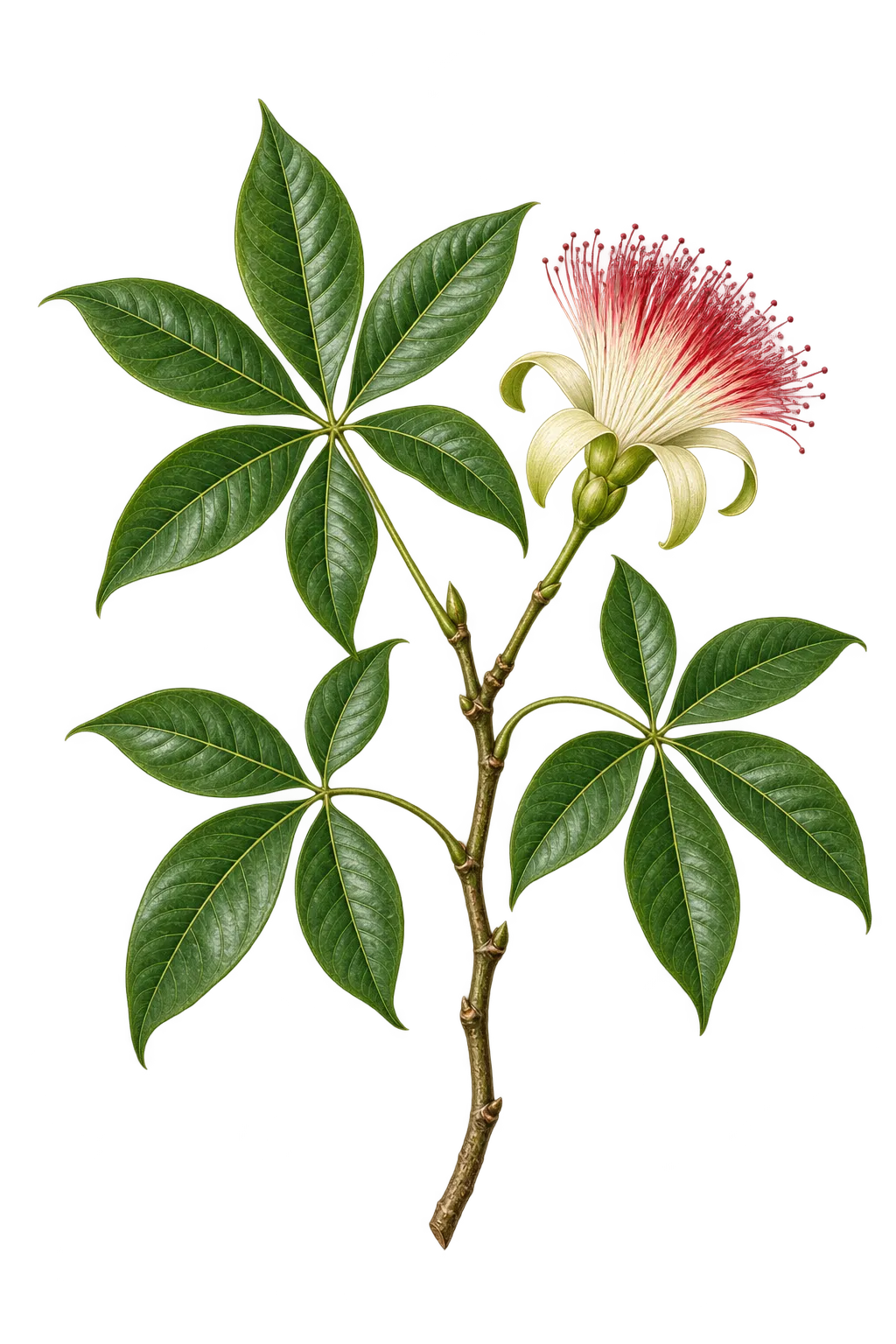
Botanical name
Kew accepts Pachira aquatica Aubl. and places it in Malvaceae. This profile follows that current family placement rather than the older Bombacaceae classification in the manifest. Kew Plants of the World Online: Pachira aquatica
Recognizing the plant
Shiny green leaves are divided like a hand into five to nine leaflets. The flowers have five cream-coloured petals surrounding a striking brush of roughly 200–250 long stamens with red tips. The fruit becomes a brown, woody capsule that opens when mature to release its seeds. North Carolina Extension Gardener Plant Toolbox: Pachira aquatica
Seasonal development
Gulf of Mexico coastal plain, Mexico
A study on Mexico’s Gulf coastal plain found that flowers opened at night and produced abundant nectar for nocturnal visitors. Hernández-Montero and Sosa (2016): Reproductive biology of Pachira aquatica
Native range
Its native range runs from Mexico through Central America into tropical South America, reaching Bolivia and northern and northeastern Brazil. Kew places it mainly in the wet tropical biome and records introductions elsewhere, including parts of tropical Africa and the Caribbean. Kew Plants of the World Online: Pachira aquatica
Ecological relationships
In that Mexican study, eight bat species carried pollen. The authors considered Leptonycteris yerbabuenae probably the most effective pollinator because it carried the greatest pollen loads. Hernández-Montero and Sosa (2016): Reproductive biology of Pachira aquatica
Sphingid moths fed on nectar, while bats and honey bees mainly collected pollen, documenting different uses of the same flowers. Hernández-Montero and Sosa (2016): Reproductive biology of Pachira aquatica
Botanical sources
- Kew Plants of the World Online: Pachira aquatica
- North Carolina Extension Gardener Plant Toolbox: Pachira aquatica
- Hernández-Montero and Sosa (2016): Reproductive biology of Pachira aquatica
Reviewed 2026-10-11. Seasonal development varies with location and growing conditions.