lily of the Nile
Agapanthus africanus (L.) Hoffmanns.
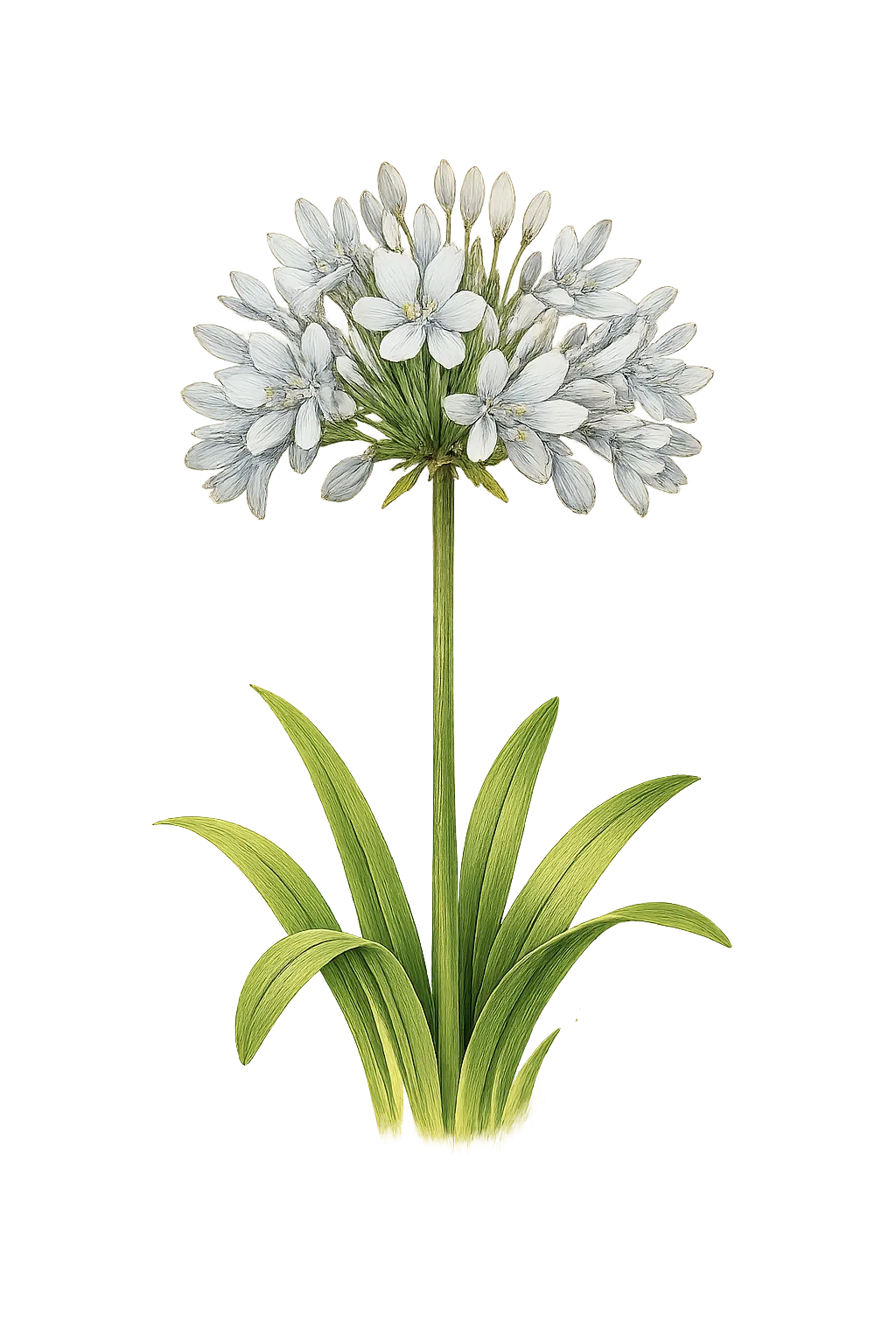
Many evergreen agapanthus labelled Agapanthus africanus are actually cultivars or hybrids of A. praecox. The true A. africanus has unusually thick, fleshy flower parts: SANBI describes these as a useful distinction from its commonly cultivated relative. Both species carry flowers in rounded clusters above strap-shaped foliage. SANBI PlantZAfrica: Agapanthus praecox
Botanical name
Kew accepts Agapanthus africanus (L.) Hoffmanns.; the stored Hoffsgg. authorship differs, but the species identity is the same. Kew POWO: Agapanthus africanus
Recognizing the plant
Its evergreen, strap-shaped leaves form a low framework for flower stalks usually under seventy centimetres tall. The open-faced flowers range from light to mainly deep blue, with white-flowered individuals occasionally recorded. The leaves average about thirty-five centimetres long. After fire, plants can resprout from thick, fleshy roots. SANBI PlantZAfrica: Agapanthus africanus
Bloom window
Western Cape, South Africa
In its Cape habitat, flowering is concentrated from December to February, during Southern Hemisphere summer. Fire can stimulate particularly abundant flowering. SANBI PlantZAfrica: Agapanthus africanus
Native range
Kew places the species in the southwestern Cape. SANBI describes its range from the Cape Peninsula east to Swellendam, in the Western Cape winter-rainfall region. Plants grow in acidic, sandy soils, often among rocks or in depressions on sandstone sheets, from sea level to about one thousand metres. Kew POWO: Agapanthus africanusSANBI PlantZAfrica: Agapanthus africanus
Ecological relationships
SANBI records bees and sunbirds among the plant’s pollinators. SANBI PlantZAfrica: Agapanthus africanus
Botanical sources
- Kew POWO: Agapanthus africanus
- SANBI PlantZAfrica: Agapanthus africanus
- SANBI PlantZAfrica: Agapanthus praecox
Reviewed 2026-10-11. Seasonal development varies with location and growing conditions.