mapleleaf viburnum
Viburnum acerifolium L.
Mapleleaf viburnum is a small deciduous woodland shrub that spreads by suckers. It commonly reaches four to six feet high in the North Carolina account. Its tolerance of shade and relatively dry soil allows it to occupy woodland settings where many showier flowering shrubs struggle. NC State Extension: Viburnum acerifolium
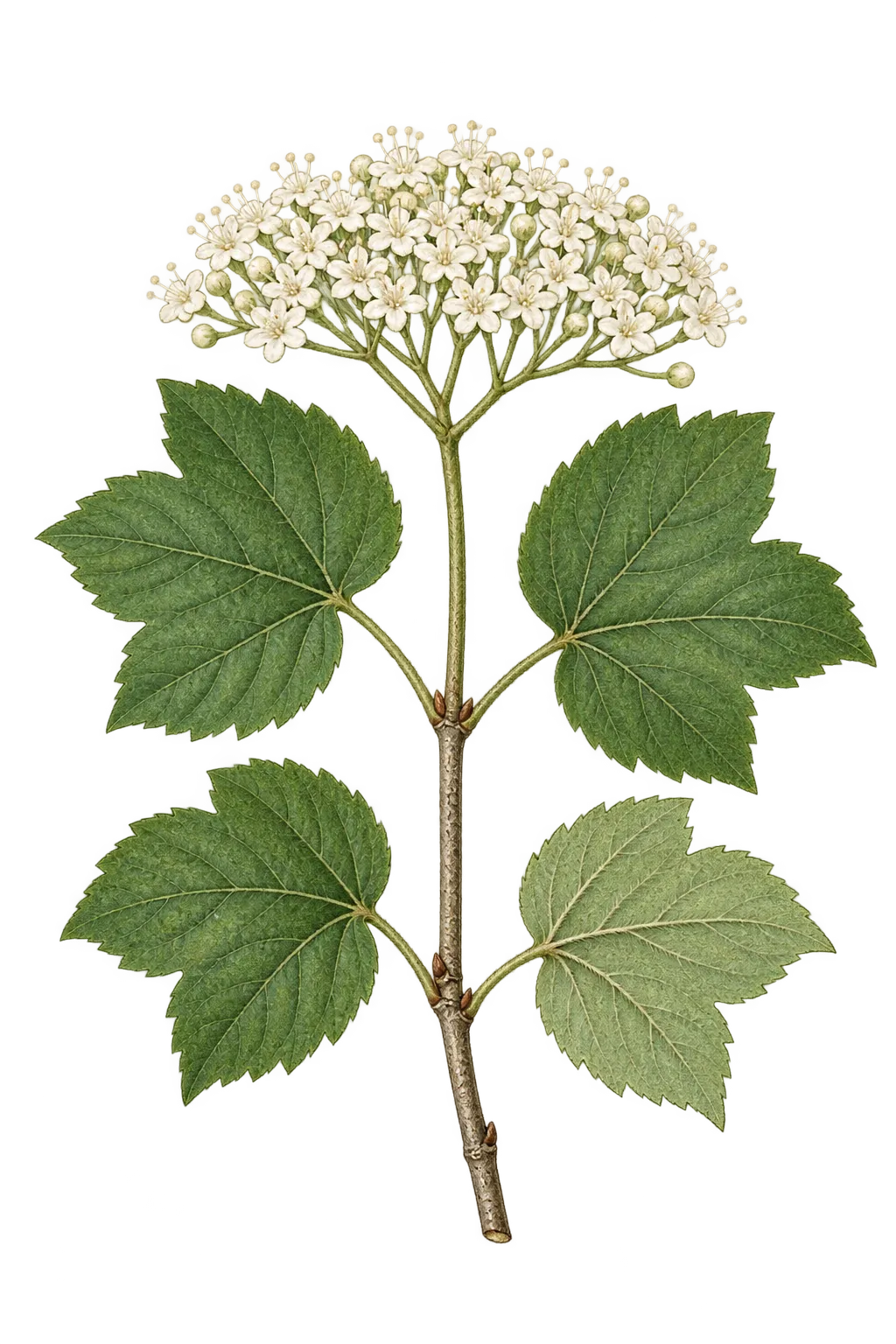
Botanical name
Kew accepts Viburnum acerifolium L. in Viburnaceae, matching the catalog’s species identity. Kew POWO: Viburnum acerifolium
Recognizing the plant
Opposite leaves usually have three pointed lobes, recalling a maple leaf on a much smaller plant. Their undersides are pale and hairy. Small white flowers form flat-topped clusters, each flower showing stamens that project beyond its petals. Rounded fruits become blue-black when mature. In autumn the foliage can turn pink, red or purple, adding a second conspicuous seasonal feature. NC State Extension: Viburnum acerifolium
Seasonal development
North Carolina extension account
Flowers appear in April–June; fruits develop in August–October and can persist into winter. NC State Extension: Viburnum acerifolium
Native range
Its native range extends from southeastern Canada through the central and eastern United States. In North Carolina it is associated with the Piedmont and mountains, growing in the understory of moist or dry woods. Kew POWO: Viburnum acerifoliumNC State Extension: Viburnum acerifolium
Ecological relationships
Songbirds, grouse, wild turkeys and squirrels eat its fruits. NC State Extension: Viburnum acerifolium
Botanical sources
Reviewed 2026-10-11. Seasonal development varies with location and growing conditions.