parsley
Petroselinum crispum (Mill.) Fuss
Parsley changes markedly between its leafy first season and its flowering second one. Young plants form a compact rosette, while older plants raise branching stems above the foliage. Though commonly grown as an annual herb, this two-year cycle allows it to flower, set seed and sometimes establish a new generation nearby. NC State Extension: Petroselinum crispum
Botanical name
The accepted Fuss combination and the database’s later Nyman ex A.W.Hill attribution share the basionym Apium crispum Mill. They denote the same parsley species. Kew: Petroselinum crispumFlora of China: Petroselinum crispum
Recognizing the plant
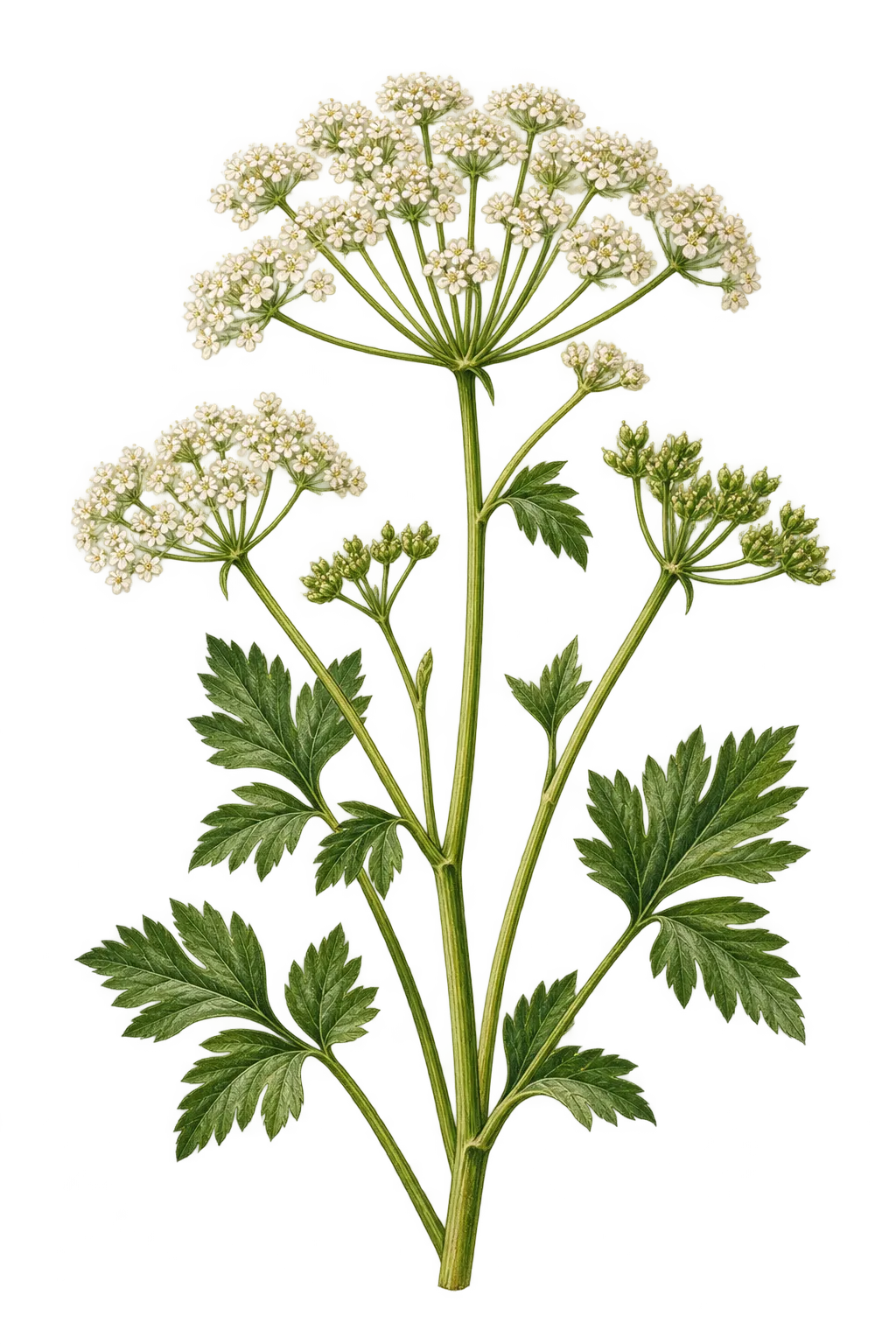
The dark green leaves are divided into smaller segments and may be flat or tightly curled, depending on the cultivated form. Basal leaves have relatively long stalks; leaves higher on the flowering stem become smaller and more narrowly divided. The stems are slender and hollow. Tiny, five-petaled greenish-yellow flowers are arranged in compound umbels, with smaller flower clusters carried on the rays of a larger umbrella-like structure. The small gray-brown fruits are ridged. Flora of China: Petroselinum crispumNC State Extension: Petroselinum crispum
Bloom window
North Carolina cultivation
Flowers appear in summer on second-year plants. NC State Extension: Petroselinum crispum
Native range
Kew places the native range in northwestern Africa and the Balkan Peninsula. Cultivation has spread parsley widely across temperate regions, where it can occur as an introduced plant outside gardens. Kew: Petroselinum crispumFlora of China: Petroselinum crispum
Ecological relationships
Parsley is a food plant for black swallowtail butterfly larvae. NC State Extension: Petroselinum crispum
Botanical sources
- Kew: Petroselinum crispum
- Flora of China: Petroselinum crispum
- NC State Extension: Petroselinum crispum
Reviewed 2026-10-11. Seasonal development varies with location and growing conditions.