sage
Salvia × bernardina Parish ex Greene
This California sage records a meeting between two distinct plants: Salvia columbariae and Salvia mellifera. A modern study of California sages discusses viable crosses found both in the wild and in garden experiments. The resulting hybrid is known as Salvia × bernardina and typically shows an intermediate combination of its parents’ features. Walker and colleagues, 2015: Relationships within California Salvia
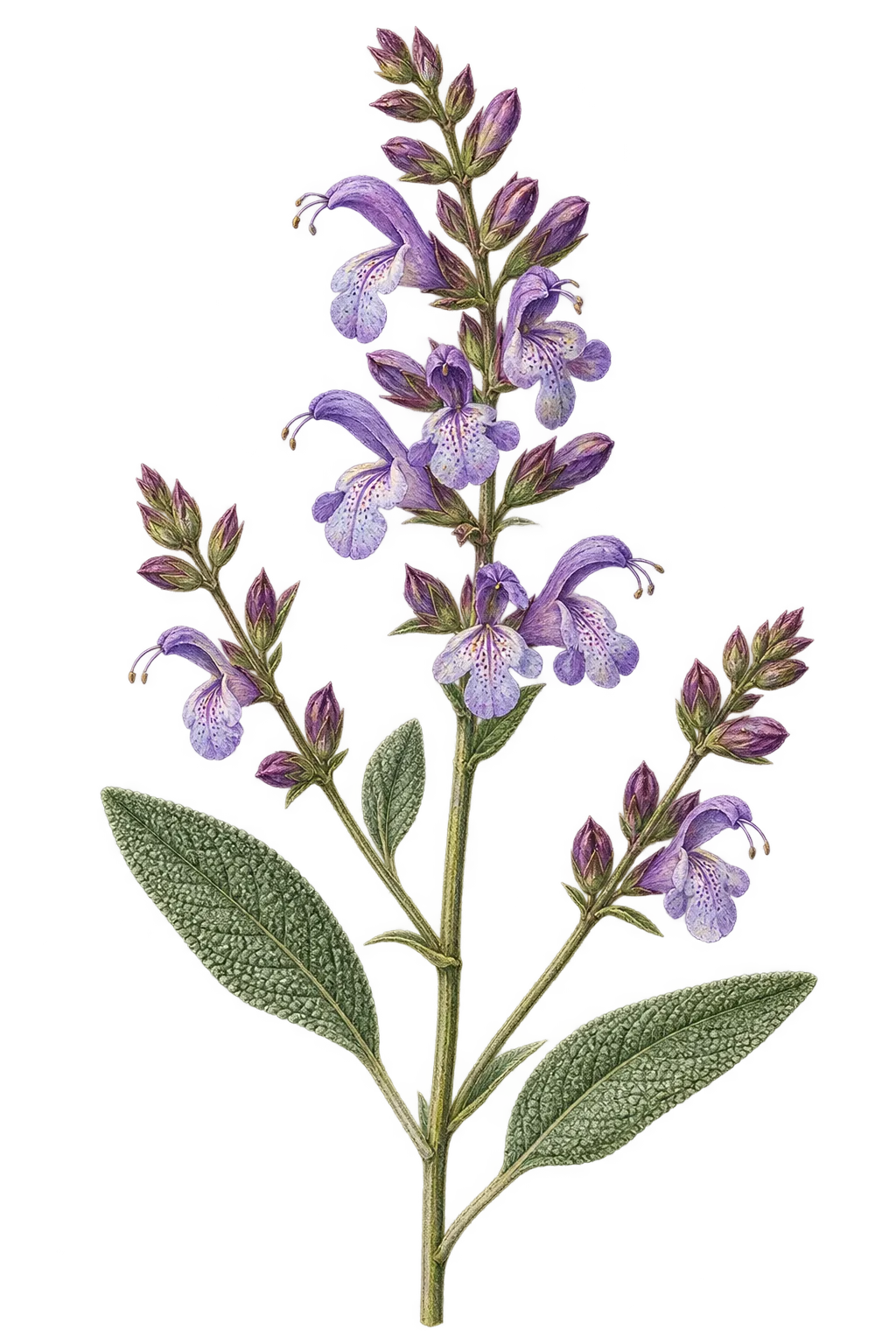
Botanical name
Salvia × bernardina Parish ex Greene is an accepted named hybrid. ITIS preserves the catalog’s “pro sp.” notation, indicating its original publication as a species. ITIS: Salvia × bernardina
Recognizing the plant
The original description portrays a plant woody near the base and several feet high, with slightly hairy to nearly smooth stems. Its lance-shaped leaves are about five centimetres long, wrinkled and green above but paler below. They are divided into rounded-toothed lobes. Numerous flower clusters are roughly two and a half centimetres across. Purple corollas extend beyond a two-lipped calyx whose upper teeth are long and bristle-like. Greene, 1885: Salvia Bernardina original description
Native range
The name was published from material gathered near San Bernardino, California, by S. B. Parish in 1885. Current taxonomic records place its native occurrence in California. The modern molecular study discusses the named hybrid as part of the naturally hybridising California sage flora. Greene, 1885: Salvia Bernardina original descriptionWorld Flora Online: Salvia × bernardinaWalker and colleagues, 2015: Relationships within California Salvia
Botanical sources
- ITIS: Salvia × bernardina
- Walker and colleagues, 2015: Relationships within California Salvia
- Greene, 1885: Salvia Bernardina original description
- World Flora Online: Salvia × bernardina
Reviewed 2026-10-11. Seasonal development varies with location and growing conditions.