sassafras
Sassafras albidum (Nutt.) Nees
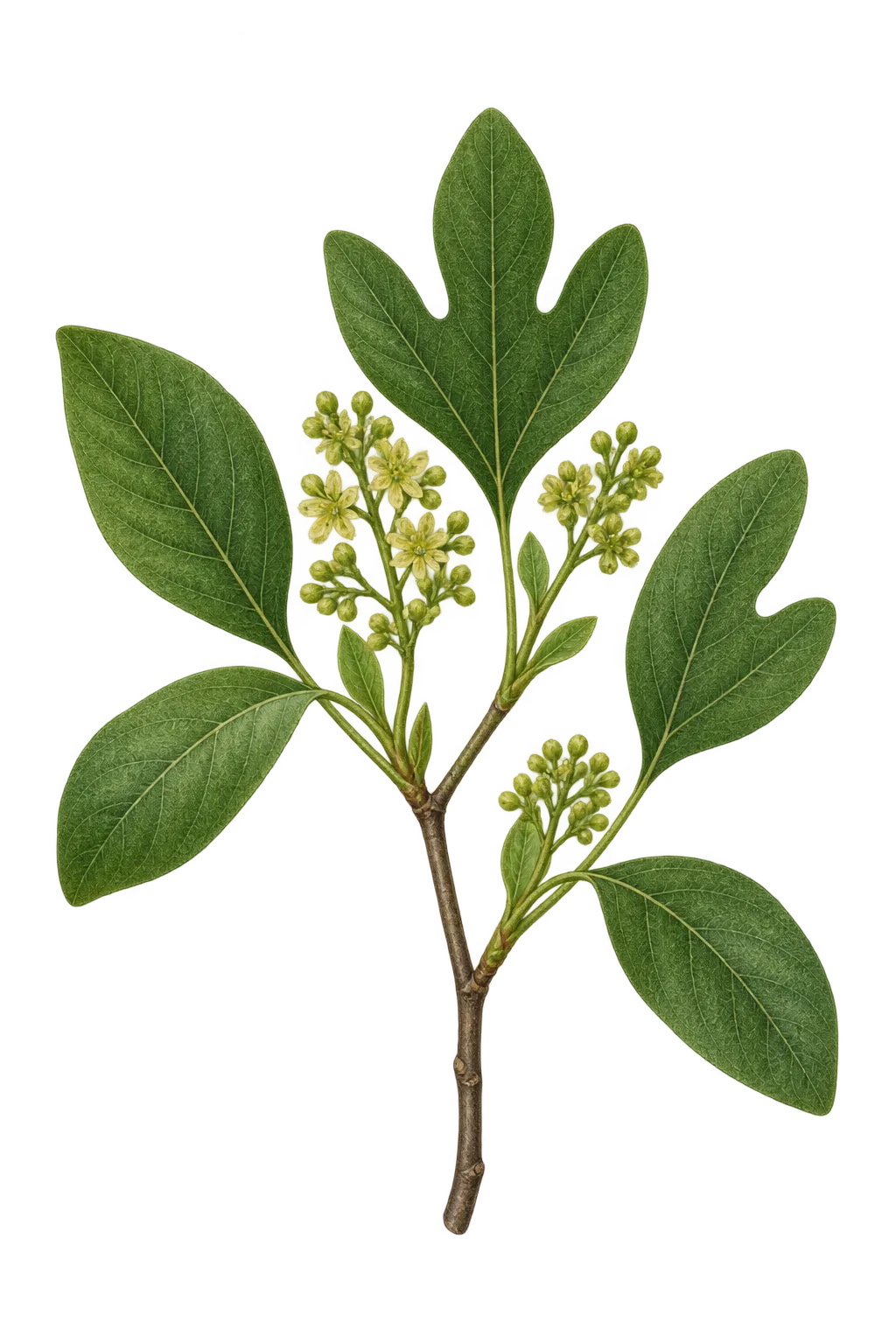
A single sassafras branch can carry three different leaf outlines: an unlobed oval, a mitten shape and a three-lobed blade. These contrasting outlines remain recognizable until the leaves turn yellow, orange or scarlet in autumn. Root suckers frequently build small groves around an established tree. Oregon State University: Sassafras albidum
Botanical name
Sassafras albidum (Nutt.) Nees is accepted in Lauraceae. Kew Medicinal Plant Names Services: Sassafras albidum
Recognizing the plant
Leaves alternate along the branches and are paler beneath than above. Older bark becomes reddish brown, deeply furrowed and corky-ridged, while younger twigs remain smoother and greener. Small yellow-green flowers appear in clusters before the foliage. Male and female flowers usually grow on separate trees. Female trees later carry blue-black, single-seeded fruits, each seated in a vivid red cup on a red stalk. NC State Extension: Sassafras albidum
Bloom window
North Carolina
North Carolina accounts place flowering in spring, followed by fruit maturation and yellow, orange or red foliage in autumn. NC State Extension: Sassafras albidum
Native range
Sassafras is native to eastern North America, from the northeastern United States and southern Canada south toward Florida and eastern Texas. It occurs in woodlands, abandoned fields and along roadsides and fences, generally on well-drained ground. NC State Extension: Sassafras albidumVascular Plants of North Carolina: Sassafras albidum
Ecological relationships
Its leaves support larvae of the spicebush swallowtail, Papilio troilus. NC State Extension: Sassafras albidum
Botanical sources
- Kew Medicinal Plant Names Services: Sassafras albidum
- NC State Extension: Sassafras albidum
- Oregon State University: Sassafras albidum
- Vascular Plants of North Carolina: Sassafras albidum
Reviewed 2026-10-11. Seasonal development varies with location and growing conditions.