white turtlehead
Chelone glabra L.
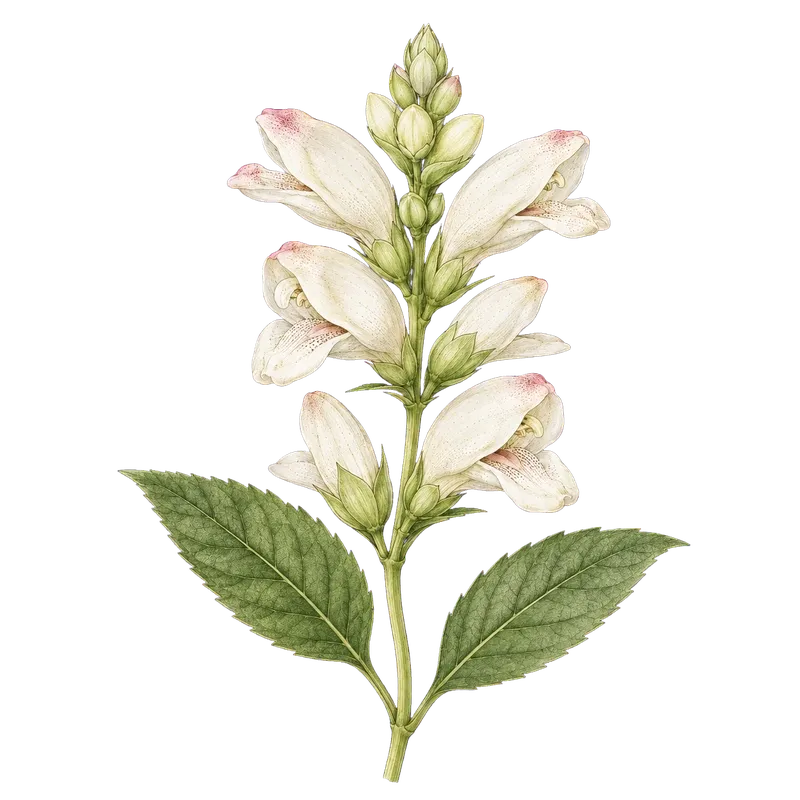
White turtlehead earns its name from a flower that looks almost closed. The upper lip arches over the lower one, forming the rounded outline that suggested a turtle’s head. Flowers gather in dense clusters at the tops of upright stems, opening progressively from the lower part of a cluster upward. White is typical, sometimes with a hint of pink. NC State Extension: White turtlehead
Botanical name
Kew accepts Chelone glabra L. in Plantaginaceae. Kew POWO: Chelone glabra
Recognizing the plant
Its narrow, sharply toothed leaves stand in opposite pairs, with successive pairs turned at right angles to one another. They attach directly to the stem or on very short stalks. The plant is an herbaceous perennial, and after flowering it produces oval capsules holding flattened, broadly winged seeds. The repeated leaf pairs give its stems an orderly structure below the more crowded flower clusters. NC State Extension: White turtlehead
Bloom window
North Carolina regional horticultural account
North Carolina’s account places the main display in late summer and autumn, extending the flowering season of moist-ground plantings. NC State Extension: White turtlehead
Native range
Chelone glabra is native to central and eastern Canada and the north-central and eastern United States. Its habitats include stream margins, floodplains, marshes, fens and moist open woodland. Kew POWO: Chelone glabraNC State Extension: White turtlehead
Ecological relationships
NC State identifies white turtlehead as a host for Baltimore checkerspot butterfly larvae (Euphydryas phaeton). NC State Extension: White turtlehead
Botanical sources
Reviewed 2026-10-11. Seasonal development varies with location and growing conditions.